
Imagine waking up one morning to discover that your bank account has been emptied, your social media accounts have been hijacked, or your personal information is being sold online. For millions of people every year, this isn’t a hypothetical scenario, it’s the reality of cybercrime.
As technology becomes more deeply integrated into our daily lives, cybercriminals continue to develop increasingly sophisticated ways to steal money, data, and identities. From phishing emails and ransomware attacks to online scams and data breaches, cybercrime has become one of the fastest-growing forms of crime in the world.
The impact extends far beyond financial losses. Cybercrime can disrupt businesses, compromise personal privacy, damage reputations, and even threaten critical infrastructure. Whether you’re an individual browsing the internet, a student using social media, or a business owner managing customer data, understanding cybercrime is essential for protecting yourself in today’s digital world.
In this guide, you’ll learn what cybercrime is, the most common types of cybercrime, real-world examples, warning signs to watch for, and practical steps you can take to stay safe online.
What Is Cybercrime?

Cybercrime refers to any criminal activity that involves computers, digital devices, networks, or the internet. In simple terms: Cybercrime is any crime committed using technology or targeting technology.
Some cybercrimes are designed to steal money, while others aim to steal information, disrupt systems, extort victims, or gain unauthorized access to digital resources. Cybercriminals may target:
- Individuals
- Businesses
- Government agencies
- Schools and universities
- Healthcare organizations
- Financial institutions
As internet usage continues to grow, so does the number of opportunities for cybercriminals.
Why Cybercrime Is Growing
Cybercrime is not increasing by accident. It is growing because our lives, finances, communications, and personal information have become more connected to the internet than ever before. As digital opportunities expand, so do the opportunities for cybercriminals.
The numbers tell the story. According to the International Telecommunication Union(ITU), approximately 6 billion people, around 74% of the world’s population, were using the internet by 2025, up significantly from 60% in 2020. That means an estimated 1.3 billion additional people came online in just five years creating a much larger pool of potential targets for cybercriminals.
At the same time, cybercrime has become increasingly profitable. The FBI’s Internet Crime Complaint Center (IC3) reported that Americans lost more than $16.6 billion to cybercrime in 2024, representing a 33% increase compared to the previous year. More than 859,000 cybercrime complaints were reported during the year.
Several major factors are driving this growth.
1. Increased Internet Usage
More people are connected to the internet than at any point in human history. From social media and online shopping to banking and healthcare services, digital platforms have become part of everyday life.
While this connectivity brings convenience, it also expands the number of devices, accounts, and users that cybercriminals can target. Every email account, smartphone, online profile, and cloud service represents a potential entry point for attackers.
2. Digital Banking and Online Payments
Financial services have undergone a massive digital transformation over the past decade. Millions of people now use mobile banking apps, digital wallets, online payment platforms, and e-commerce websites daily.
The more money that moves online, the more attractive digital platforms become to criminals seeking financial gain. Cybercriminals increasingly target payment systems, banking credentials, credit card information, and cryptocurrency assets because they can often be monetized quickly.
3. Remote and Hybrid Work
The rise of remote and hybrid work has created new cybersecurity challenges for organizations and employees alike.
Employees frequently access company resources from home networks, personal devices, and remote collaboration tools. While these technologies improve flexibility, they also create additional attack surfaces that criminals can exploit. Security researchers continue to report increased targeting of remote-access tools, VPNs, and employee credentials by cybercriminal groups.
4. Personal Data Has Become Extremely Valuable
In today’s digital economy, personal information is a highly valuable commodity. Cybercriminals can profit from stolen:
- Login credentials
- Credit card information
- Social Security numbers
- Medical records
- Banking details
- Email accounts
This data can be sold on underground marketplaces, used for identity theft, leveraged in fraud schemes, or employed in future cyberattacks. The financial value of personal information continues to fuel cybercrime worldwide.
5. Global Connectivity
Unlike traditional crimes, cybercriminals do not need to be physically present to target victims. A scammer operating from one country can target thousands of individuals or businesses across multiple continents simultaneously. The internet has effectively removed geographical barriers, allowing cybercriminals to scale their operations far beyond what would be possible offline.
6.Cybercrime Is Becoming More Sophisticated
Modern cybercriminals increasingly use automation, artificial intelligence, phishing kits, malware-as-a-service platforms, and stolen credential databases to conduct attacks at scale.
This means attackers can launch thousands, or even millions, of fraudulent emails, messages, or login attempts in a relatively short period, increasing both the volume and effectiveness of cybercrime campaigns.
| Growth Driver | Relative Impact |
| Increased Internet Usage | 100 |
| Digital Payments & Banking | 95 |
| Valuable Personal Data | 90 |
| Remote & Hybrid Work | 85 |
| Global Connectivity | 80 |
| AI & Automation Tools | 78 |
Cybercrime growth is being driven by a combination of increased connectivity, expanding digital financial systems, valuable personal data, and increasingly sophisticated attack methods.
The bottom line is simple: as society becomes more digital, cybercrime becomes a larger and more profitable industry. Understanding the forces driving this growth helps explain why cybersecurity awareness is no longer just an IT concern, it is an essential skill for individuals, businesses, and communities alike.
Common Types of Cybercrime
Cybercrime comes in many forms. Understanding the most common types can help you recognize and avoid potential threats.
1. Phishing Attacks: Phishing occurs when criminals impersonate trusted organizations to trick victims into revealing sensitive information. Common targets include:
- Banking credentials
- Passwords
- Credit card details
- Personal information
Phishing often arrives through emails, text messages, social media messages, or fake websites.
2. Identity Theft: Cybercriminals steal personal information and use it to commit fraud. This may involve:
- Opening accounts
- Applying for loans
- Making purchases
- Accessing financial services
Identity theft can cause long-term financial and legal complications.
3. Ransomware: Ransomware is malicious software that locks or encrypts a victim’s files until a payment is demanded. Victims may include:
- Individuals
- Businesses
- Hospitals
- Schools
- Government agencies
Some organizations have suffered millions of dollars in losses from ransomware attacks.
4. Malware: Malware is a broad term for malicious software designed to damage, disrupt, or gain unauthorized access to systems. Examples include:
- Viruses
- Worms
- Trojans
- Spyware
- Keyloggers
Malware can steal information, monitor activity, or compromise devices.
5. Online Fraud: Fraudsters use digital platforms to deceive victims into sending money or revealing information. Examples include:
- Fake online stores
- Investment scams
- Romance scams
- Lottery scams
- Marketplace fraud
6. Data Breaches: A data breach occurs when sensitive information is accessed or exposed without authorization. Compromised data may include:
- Passwords
- Customer records
- Financial information
- Medical records
7. Social Media Scams: Cybercriminals exploit social media platforms to:
- Impersonate individuals
- Spread malicious links
- Conduct phishing campaigns
- Run fraudulent promotions
8. Business Email Compromise (BEC): In these attacks, criminals impersonate executives, employees, or trusted partners to trick organizations into sending money or sensitive information.
How Cybercriminals Gain Access
Cybercriminals often exploit simple mistakes rather than advanced technical vulnerabilities. Common methods include:
1. Weak Passwords: Simple or reused passwords make accounts easier to compromise.
2. Unpatched Software: Outdated software may contain security vulnerabilities.
3. Suspicious Links: Malicious links can install malware or steal credentials.
4. Public Wi-Fi Risks: Unsecured networks can expose sensitive information.
5. Social Engineering: Manipulating people into revealing information remains one of the most effective attack methods.
How to Protect Yourself From Cybercrime
Cybersecurity doesn’t have to be complicated. Several simple habits can dramatically reduce risk.
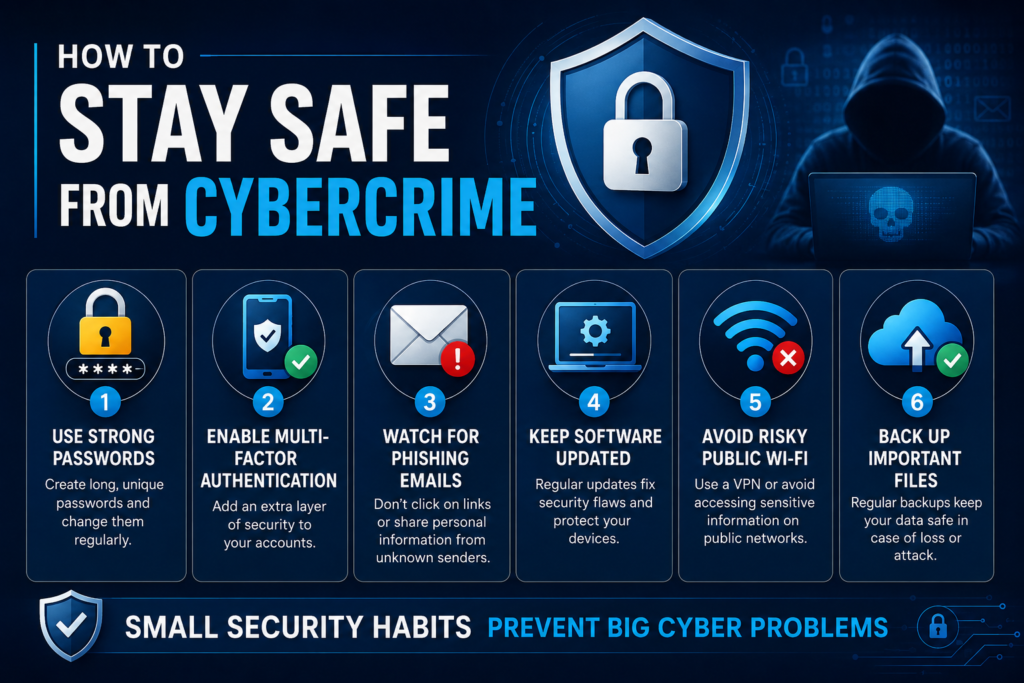
1.Use Strong Passwords: Create unique passwords for every account.
A password manager can help manage them securely.
2. Enable Multi-Factor Authentication (MFA): MFA adds an additional layer of protection beyond passwords.
3. Keep Software Updated: Updates often contain important security fixes.
4. Be Skeptical of Unexpected Messages: Verify emails, texts, and requests before responding.
5. Back Up Important Files: Regular backups can help recover data after ransomware attacks or hardware failures.
6. Use Secure Networks: Avoid sensitive transactions on unsecured public Wi-Fi whenever possible.
7. Monitor Financial Accounts: Regularly review transactions and account activity.
Cybercrime and Texas

Texas is not only one of the largest states in the country, it is also one of the most frequently targeted by cybercriminals. With a population exceeding 31 million people, a thriving business environment, major financial institutions, and one of the nation’s largest technology sectors, Texas presents an attractive target for a wide range of cyber threats.
According to the FBI’s Internet Crime Complaint Center (IC3), Texas ranked second in the United States for reported cybercrime complaints in 2024, with 62,347 complaints filed by residents and organizations. Texans also reported approximately $1.35 billion in cybercrime-related losses, an increase of more than $328 million compared to the previous year, highlighting the growing financial impact of online crime across the state.
Cybercrime in Texas affects individuals, businesses, schools, healthcare providers, and government agencies alike. While attacks vary in sophistication, most fall into several recurring categories.
The Most Common Cybercrimes Reported in Texas
Texas residents most frequently reported:
- Identity theft
- Financial fraud
- Phishing and spoofing attacks
- Personal data breaches
- Online shopping and marketplace scams
- Business Email Compromise (BEC)
- Cryptocurrency fraud
- Ransomware attacks
In 2025, the top cybercrime categories by complaint volume in Texas included:
| Crime Type | Complaints Reported |
| Extortion | 7,854 |
| Personal Data Breaches | 5,424 |
| Phishing/Spoofing | 3,987 |
Meanwhile, the crimes responsible for the greatest financial losses were:
| Crime Type | Estimated Losses |
| Investment Fraud | $636 Million |
| Business Email Compromise | $293.5 Million |
| Tech Support Scams | $86.7 Million |
These figures demonstrate that while some cybercrimes occur more frequently, others cause substantially greater financial damage to victims. As healthcare, manufacturing, financial services, government facilities, and information technology. These industries are all heavily represented within Texas’s economy.
Final Words
Cybercrime has become one of the defining security challenges of the digital age. As technology continues to evolve, cybercriminals are finding new ways to exploit vulnerabilities, steal information, and target both individuals and organizations. From phishing scams and identity theft to ransomware and data breaches, the threat landscape continues to expand alongside our increasing reliance on digital services.
The good news is that many cybercrimes can be prevented through awareness and good security practices. Simple habits such as using strong passwords, enabling multi-factor authentication, keeping software updated, and exercising caution online can significantly reduce the risk of becoming a victim. While no system is completely immune to attack, informed users are far more difficult targets for cybercriminals.
Ultimately, cybersecurity is not just about technology, it’s about behavior. The more you understand how cybercrime works, the better equipped you’ll be to recognize threats, protect your personal information, and navigate the digital world safely. In an era where so much of life happens online, cybersecurity awareness is no longer optional; it is an essential life skill.