Most crimes have one thing in common: they generate money. Whether the profits come from fraud, drug trafficking, cybercrime, corruption, organized theft, or other illegal activities, criminals face a major challenge after obtaining the money. How do they use it without attracting attention from law enforcement or financial institutions?
This is where money laundering comes in. Money laundering is the process of making illegally obtained money appear legitimate. It allows criminals to disguise the true source of their funds and integrate those proceeds into the legal financial system. Without money laundering, many large-scale criminal operations would struggle to spend or invest their profits without raising suspicion.
While the term is frequently mentioned in movies, crime documentaries, and news reports, many people do not fully understand what money laundering is, how it works, or why it poses such a serious threat to economies and financial systems worldwide.
In this beginner’s guide, we’ll break down the concept of money laundering, explain how it works, explore common laundering methods, discuss warning signs investigators look for, and examine how governments and financial institutions work to combat it.
What Is Money Laundering?
Money laundering is the process of concealing the origins of money obtained through illegal activities and making it appear as though it came from legitimate sources.
In simple terms: Money laundering turns “dirty money” into “clean money.” The goal is to hide the connection between criminal activity and the financial proceeds generated by that activity. Criminals may attempt to launder money earned from:
- Drug trafficking
- Fraud schemes
- Cybercrime
- Human trafficking
- Corruption and bribery
- Illegal gambling
- Organized crime
- Financial scams
Once laundered, the money can be spent, invested, transferred, or deposited with a much lower risk of detection.
Why Is Money Laundering a Problem?
Money laundering does more than help criminals hide money. It can:
- Support organized crime networks
- Fund additional criminal activities
- Undermine financial institutions
- Distort economic activity
- Facilitate corruption
- Reduce public trust in financial systems
Governments around the world spend billions of dollars each year investigating and preventing money laundering because it enables many other forms of crime to continue operating.
How Does Money Laundering Work?
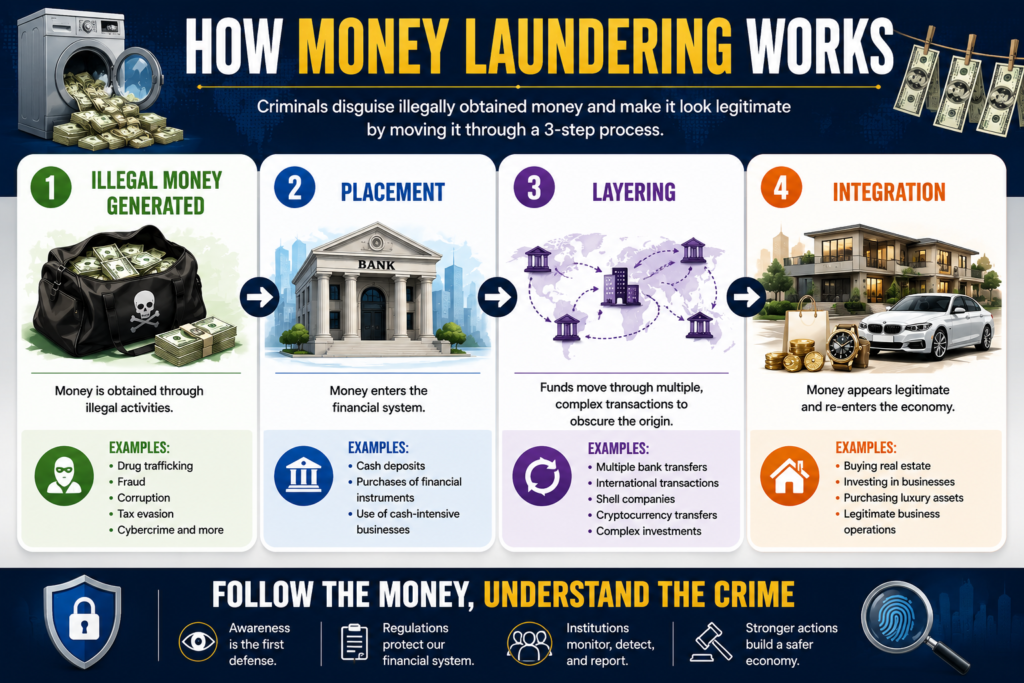
Although laundering schemes can be extremely sophisticated, many follow the same basic framework. The process is often described in three stages.
Stage 1: Placement
This is the point where illegal money first enters the financial system. Examples include:
- Depositing cash into bank accounts
- Purchasing assets
- Using cash-intensive businesses
- Converting cash into other financial instruments
The goal is to move the money away from its criminal source.
Stage 2: Layering
Layering involves creating complex transactions designed to obscure the origin of funds. Methods may include:
- Multiple bank transfers
- International transactions
- Shell companies
- Cryptocurrency transfers
- Complex investment activities
This stage makes it more difficult for investigators to trace the money.
Stage 3: Integration
The final stage occurs when the money re-enters the legitimate economy. Examples include:
- Purchasing real estate
- Investing in businesses
- Buying luxury assets
- Funding legitimate ventures
At this point, the money may appear to have come from lawful sources.
Common Money Laundering Methods
Criminals constantly develop new techniques to disguise illicit funds. Some of the most common methods include:
1. Structuring (“Smurfing”): Large amounts of cash are broken into smaller transactions to avoid reporting requirements. For example, instead of depositing $50,000 at once, a criminal may deposit smaller amounts over time.
2. Shell Companies: A shell company is a business that exists primarily on paper and may have little or no legitimate operations. These entities can be used to move money through multiple accounts and transactions.
3. Real Estate Transactions: Property purchases are sometimes used to conceal illicit funds. Real estate can provide a way to convert cash into an asset that may later be sold or transferred.
4. Cash-Intensive Businesses: Businesses that regularly handle large amounts of cash may be exploited to mix illegal funds with legitimate revenue. Examples often include:
- Restaurants
- Car washes
- Convenience stores
- Entertainment venues
It’s important to note that the vast majority of these businesses operate legally.
5. Cryptocurrency Laundering: As digital assets have become more common, some criminals have attempted to use cryptocurrency transactions to obscure the movement of funds. However, many blockchain transactions remain traceable, and law enforcement agencies increasingly use advanced blockchain analytics tools.
What Is Anti-Money Laundering (AML)?
Anti-Money Laundering (AML) refers to the laws, regulations, policies, and procedures designed to detect, prevent, and report money laundering activities. AML frameworks exist to make it more difficult for criminals to hide the proceeds of illegal activities within the legitimate financial system.
Governments and regulatory agencies around the world require certain businesses and financial institutions to implement AML programs that help identify suspicious transactions and reduce financial crime risks.
AML programs are commonly used by:
- Banks
- Credit unions
- Investment firms
- Cryptocurrency exchanges
- Insurance companies
- Money service businesses
- Payment processors
- Other regulated financial institutions
These organizations are often required to monitor customer activity, verify identities, maintain transaction records, and report suspicious behavior to the appropriate authorities.
Key Components of AML Programs
Most AML programs are built around several core principles:
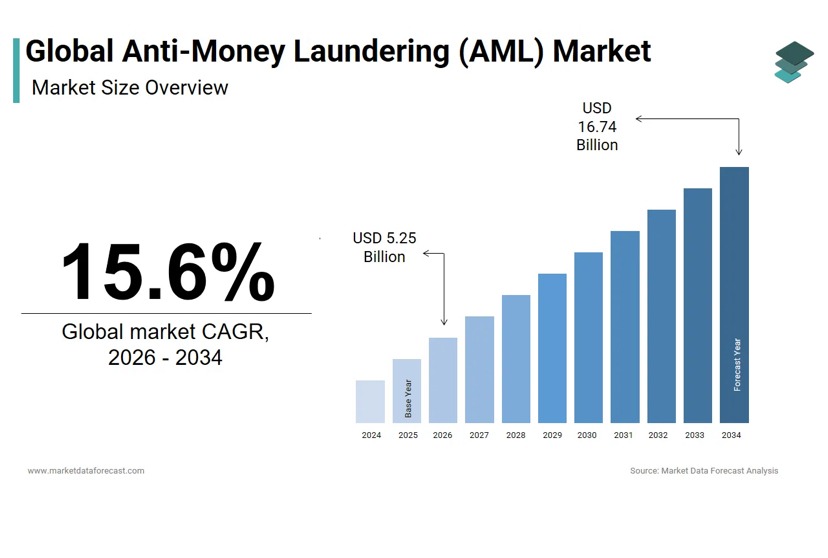
Source: Anti-Money Laundering projected market cap according to marketdata forcast
Customer Due Diligence (CDD): Financial institutions must verify the identity of their customers and understand the nature of their financial activities. This process helps prevent criminals from opening accounts using false or stolen identities.
Know Your Customer (KYC): KYC procedures require institutions to collect and verify information such as a customer’s name, address, date of birth, and identification documents. KYC serves as the first line of defense against money laundering and other financial crimes.
Transaction Monitoring: Banks and other financial institutions use automated systems to monitor account activity and identify unusual patterns that may indicate money laundering.
Examples include:
- Large cash deposits
- Frequent international transfers
- Sudden spikes in account activity
- Multiple transactions structured to avoid reporting thresholds
Suspicious Activity Reporting (SAR): When a financial institution detects potentially suspicious behavior, it may be required to file a Suspicious Activity Report (SAR) with the relevant regulatory or law enforcement agency for further investigation.
Record Keeping: AML regulations often require institutions to maintain detailed customer and transaction records for several years. These records can become valuable evidence during investigations.
Why AML Matters
Anti-Money Laundering efforts do more than protect banks, they help safeguard the entire financial system. Effective AML programs make it harder for criminal organizations, fraud networks, corrupt officials, and cybercriminals to move and use illicit funds.
By identifying suspicious financial activity early, AML measures help disrupt crimes such as:
- Fraud and financial scams
- Drug trafficking
- Human trafficking
- Terrorist financing
- Corruption and bribery
- Cybercrime and ransomware attacks
In today’s digital economy, where money can move across borders within seconds, AML has become one of the most important tools for maintaining transparency, accountability, and trust in the global financial system.
Red Flags That May Indicate Money Laundering
Financial institutions and investigators often look for warning signs such as:
1. Unusual Cash Deposits: Large or frequent cash transactions that do not match normal account activity.
2. Multiple Small Transactions: A pattern of smaller deposits designed to avoid reporting thresholds.
3. Complex Transfers: Money moving through numerous accounts without a clear business purpose.
4. Sudden Account Activity: Dormant accounts becomes highly active without explanation.
5. Use of Multiple Businesses: Funds moving through several unrelated companies or entities.
A single red flag does not necessarily indicate criminal activity, but multiple indicators may warrant further investigation.
How Banks Help Combat Money Laundering
Modern financial institutions use sophisticated monitoring systems to identify suspicious activity.
Banks may:
- Verify customer identities
- Monitor transaction patterns
- File Suspicious Activity Reports (SARs)
- Conduct enhanced due diligence
- Report certain large transactions
These measures help reduce opportunities for financial crimes.
Money Laundering in the Digital Age
Technology has transformed how money moves around the world. While digital payments and cryptocurrencies have created new opportunities for criminals, they have also provided investigators with new tools.
Today, law enforcement agencies increasingly rely on:
- Data analytics
- Transaction monitoring
- Artificial intelligence
- Blockchain analysis
- International cooperation
to identify and disrupt laundering operations and tackle suspicious monetary and financial activities.
Common Misconceptions About Money Laundering
1. “Only Drug Cartels Launder Money”
False.Money laundering is associated with many types of crime, including fraud, cybercrime, corruption, tax crimes, and financial scams.
2. “Money Laundering Is Always Complex”
Not necessarily. Some laundering schemes involve surprisingly simple methods.
3. “Cryptocurrency Makes Money Untraceable”
False. Many cryptocurrency transactions leave permanent records that investigators can analyze.
How Ordinary People Can Protect Themselves
While most people will never knowingly participate in money laundering, individuals can reduce risk by:
• Avoiding suspicious financial schemes
• Verifying business opportunities
• Being cautious of requests to move money for others
• Monitoring financial accounts
• Reporting suspected fraud
• Understanding common financial crime tactics
Never allow your bank account to be used by strangers or unfamiliar businesses.
Why Understanding Money Laundering Matters
Many people assume money laundering only affects criminals and financial institutions. In reality, its impact reaches much further.
Money laundering helps fund organized crime, supports fraud networks, facilitates corruption, and enables other criminal enterprises to continue operating. Understanding how it works helps citizens recognize financial crime risks and appreciate the safeguards designed to protect the financial system.
In Summary
Money laundering is often described as the financial engine that keeps many criminal enterprises running. By disguising the origins of illegally obtained money, criminals can use, invest, and move funds while attempting to avoid detection. Although the methods used may vary, from cash businesses and shell companies to complex international transfers and digital assets, the underlying objective remains the same: making illicit money appear legitimate.
Understanding the basics of money laundering is important because it reveals how financial crime extends beyond individual offenses. Fraud, cybercrime, corruption, trafficking, and organized crime frequently rely on laundering schemes to conceal profits and sustain operations. This is why governments, regulators, and financial institutions devote significant resources to anti-money laundering efforts.
For most people, the key takeaway is awareness. Recognizing common warning signs, avoiding suspicious financial arrangements, and understanding how money laundering works can help individuals avoid becoming unwitting participants in criminal schemes. In an increasingly interconnected financial world, informed citizens play an important role in supporting transparency, accountability, and the integrity of the financial system.