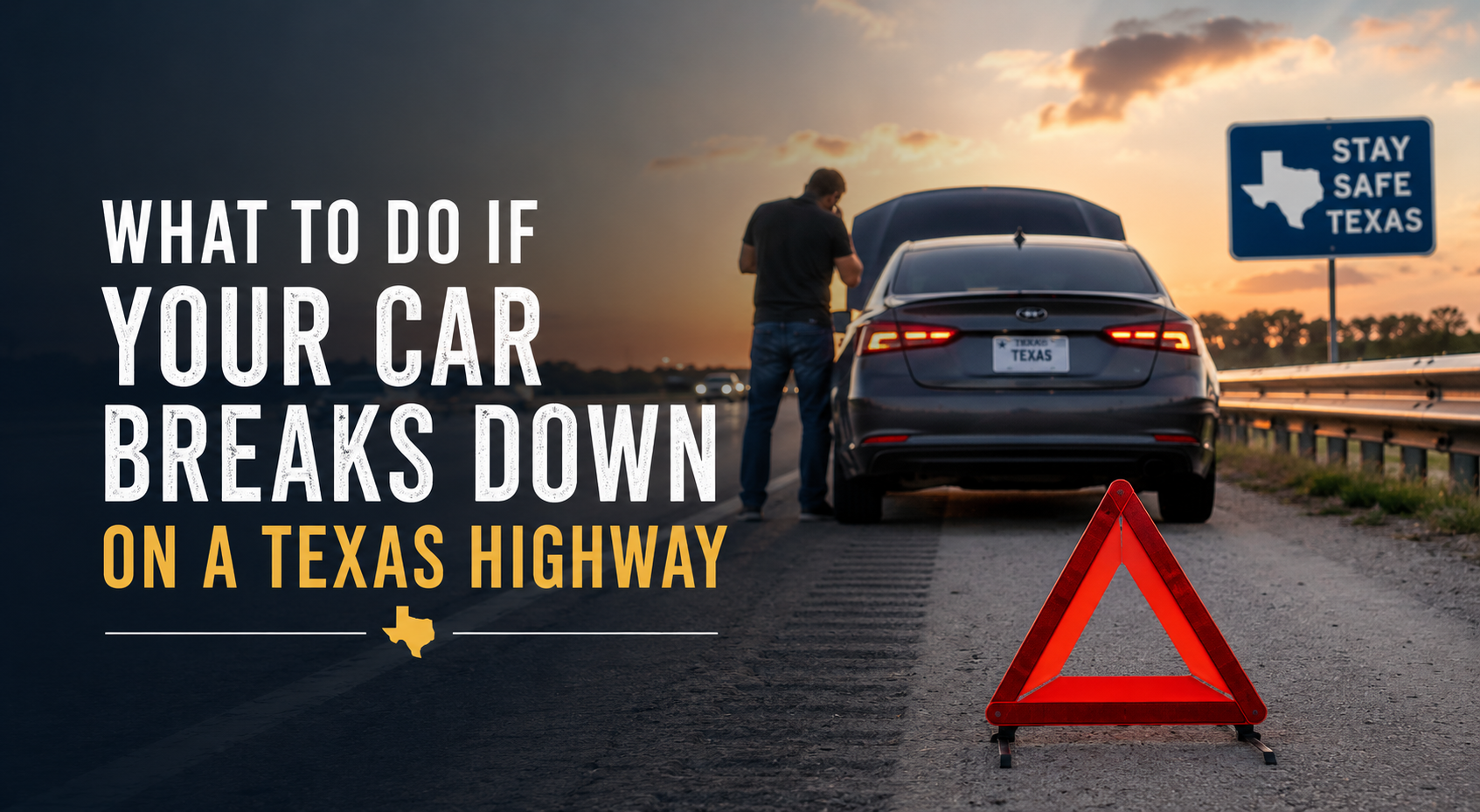
A vehicle breakdown is inconvenient anywhere. On a Texas highway, however, it can become a genuine safety emergency. A flat tire on a quiet residential street is one thing. A disabled vehicle on the shoulder of a busy interstate, with vehicles traveling at highway speeds only a few feet away, is something entirely different.
Texas roads also present some unique challenges. Long highway stretches can leave drivers far from services, while extreme summer temperatures can make remaining outside a vehicle dangerous. Weather can change quickly, and rural highways may have limited lighting, nearby facilities or reliable cellular coverage. The safest response is therefore not simply “call a mechanic.” The priority is; Get out of immediate danger, make the vehicle visible, communicate your location and avoid unnecessary exposure to traffic or strangers.
Texas Department of Public Safety guidance recommends staying calm, getting the vehicle as far off the traveled portion of the highway as possible and turning on the hazard lights. DPS also advises that, when possible, motorists should remain with the vehicle until uniformed law enforcement arrives, particularly at night or during bad weather.
In this guide, we’d be touching on a practical roadside safety guide for Texas drivers, including what to do on interstates, at night, during extreme heat and when help is approaching
Why a Highway Breakdown Can Be Dangerous
A disabled vehicle creates an unusual situation: you are stationary while everyone around you is still moving. That matters because Texas highways can have high speed limits. State law allows maximum posted limits of up to 85 mph on qualifying highways, with 80 mph permitted on portions of I-10 and I-20 in certain areas. The danger isn’t necessarily the mechanical failure itself. It can come from:
- Passing traffic
- Distracted drivers
- Vehicles drifting onto the shoulder
- Poor visibility
- Nighttime conditions
- Severe weather
- Extreme heat
- Being stranded far from assistance
- Walking alongside a highway
- Approaching unfamiliar motorists
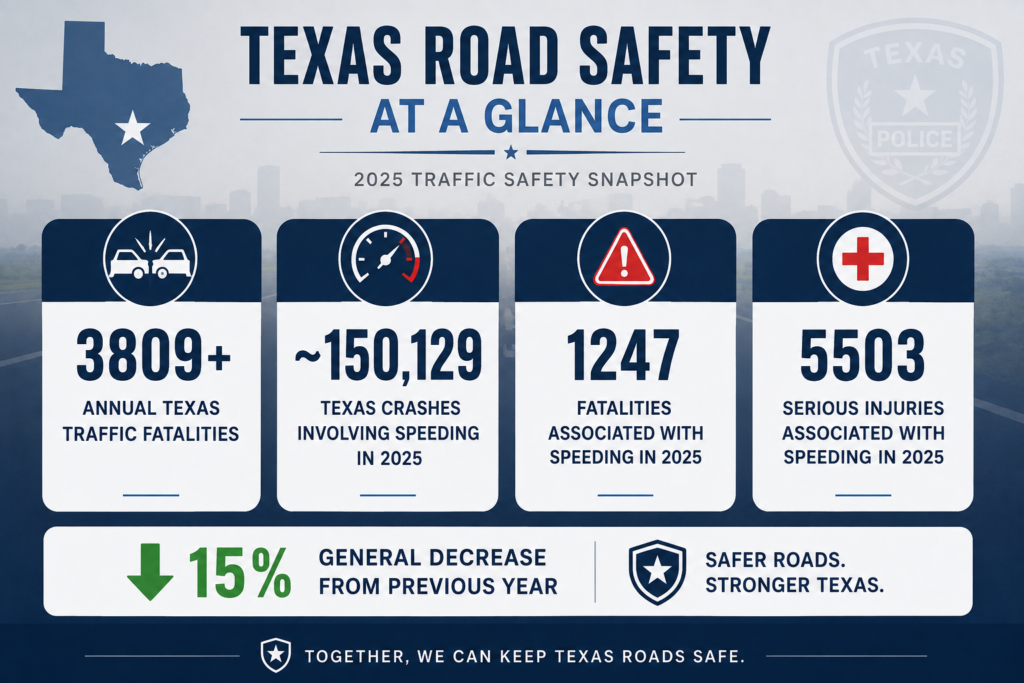
Texas records more than 3,000 traffic fatalities annually, according to TxDOT’s statewide safety campaign. That broader road-safety environment is why a breakdown should be treated as a roadside safety situation, not merely a mechanical problem.
What to Do Immediately After Your Car Breaks Down
If your vehicle suddenly loses power, develops a serious mechanical problem or gets a flat tire, don’t panic. Follow these steps.
1. Stay Calm and Assess the Situation
Keep control of the vehicle and avoid making sudden movements. If the vehicle is still moving, determine whether you can safely reach:
- The shoulder
- An emergency pull-off
- A rest area
- A nearby parking area
- Another location completely separated from moving traffic
If you can safely move the vehicle away from the travel lanes, do so. TxDOT similarly advises motorists involved in a crash to move a vehicle out of the flow of traffic when it can be done safely.
2. Get as Far Away From Moving Traffic as Safely Possible
This is one of the most important steps. A vehicle sitting partly in an active travel lane is considerably more dangerous than one completely on the shoulder.
If you can reach the shoulder without creating another hazard, move over. But don’t take unnecessary risks trying to push or maneuver a vehicle when traffic conditions make doing so dangerous. Your goal is to get out of the traffic stream, not to achieve a perfect parking position at any cost.
3. Turn on Your Hazard Lights
Activate your emergency flashers immediately. They tell approaching drivers that your vehicle is disabled and may help distinguish it from normal traffic.
If your vehicle has additional emergency warning equipment, use it only when appropriate and safely. Texas DPS specifically recommends making a disabled vehicle visible by turning on the flashers.
4. Make Yourself Visible , But Don’t Stand in Traffic
Visibility is important. At the same time, standing beside a disabled vehicle on a highway shoulder can be extremely dangerous. If you are safely inside the vehicle and there is no immediate reason to leave, remaining inside can provide protection from passing traffic and weather.
Texas DPS recommends staying with the vehicle when possible, particularly at night or in bad weather. This is where context matters. There is no universal rule that says; “Always stay inside.” or “Always get out.” The safest choice depends on where the vehicle is positioned and what hazards surround it.
Should You Stay Inside the Car?
Usually, if the vehicle is safely off the roadway and there is no immediate danger, staying with the vehicle is preferable. Your vehicle provides:
- Shelter from weather
- Protection from traffic
- A visible landmark for rescuers
- Access to your phone and supplies
- A physical barrier between you and strangers
This becomes especially important at night. DPS specifically advises motorists to remain with their vehicle until uniformed law enforcement arrives when possible, particularly during nighttime or bad weather.
But there are exceptions.
If the vehicle is:
- On fire
- Filling with smoke
- In danger of being struck
- In rising floodwater
- Exposed to another immediate hazard
remaining inside may be more dangerous. In an immediate emergency, prioritize getting yourself to a safe location and contacting 911.
What If Your Car Is Stopped in a Travel Lane?
This is a more serious situation. If the vehicle cannot be moved and is blocking traffic, activate your hazards and contact emergency services. Don’t stand behind the vehicle trying to direct traffic yourself.
Don’t attempt complicated repairs while vehicles are passing close by. And don’t assume that other drivers will see you. At highway speeds, even a small distraction or late lane change can have devastating consequences.
What If You Break Down at Night?
Nighttime changes the equation. Visibility is reduced, and approaching drivers may have less time to recognize a stationary vehicle. If you break down at night:
- Turn on your hazard lights.
- Keep the vehicle visible.
- Stay inside if the vehicle is safely positioned.
- Keep your doors locked.
- Contact roadside assistance or emergency services.
- Don’t accept rides from strangers unless there is a compelling safety reason and you have assessed the situation carefully.
Texas DPS specifically recommends keeping your doors locked and only cracking the window if someone stops to offer assistance, asking that person to contact law enforcement for help.
What If Someone Stops to Help?
Most people who stop may simply be trying to help. You still don’t have to open your door. You can communicate through a partially opened window or simply tell them: “Thank you. Help is already on the way.” DPS specifically advises stranded motorists who receive offers of help to keep the doors locked, crack a window and ask the person to call law enforcement for assistance. That approach lets you receive assistance without unnecessarily exposing yourself to a stranger.
That it is also important to not Walk Along the Highway Unless You Absolutely Have To, as one of the most dangerous mistakes a stranded driver can make is deciding; “I’ll just walk to the next gas station.” That might be reasonable on a quiet local road. On a high-speed highway, walking along the shoulder can expose you to traffic, debris, weather and other hazards. If you leave your vehicle because of an immediate danger, move toward the safest accessible location, rather than simply following the highway.
If you absolutely must leave the vehicle and arrange transportation, DPS recommends writing down identifying information such as your name, departure time, direction of travel and details about the vehicle or person providing transportation, and notifying law enforcement about the circumstances.
Texas Heat Makes Highway Breakdowns More Serious
This deserves its own section. Texas summer heat can transform a roadside breakdown into a potentially dangerous situation surprisingly quickly.
The Texas Department of Public Safety warns that extreme heat can affect vehicles themselves, including batteries, engines and tires. DPS recommends keeping an emergency kit in the vehicle with items including a phone charger, flashlight, jumper cables, first-aid supplies, water and nonperishable food.
If you break down during extreme heat:
- Stay hydrated.
- Use the vehicle’s available shade and ventilation appropriately.
- Avoid unnecessary physical exertion.
- Don’t walk long distances in extreme heat.
- Contact help early rather than waiting until your situation becomes critical.
- If you or another passenger begins showing signs of a serious heat-related emergency, call 911.
A breakdown isn’t the time to discover that your phone has 4% battery and you have no water.
What If Your Car Breaks Down During a Texas Storm?
Weather can make an already difficult situation considerably worse. Heavy rain can reduce visibility. Flooding can make roads impassable. Lightning can create additional hazards. And severe weather can turn a roadside stop into an emergency. If water begins rising around the vehicle, do not assume the vehicle is a safe shelter simply because you are inside it.
Avoid driving into flooded roadways in the first place. If you’re already trapped by rising water, prioritize emergency assistance and follow instructions from authorities. During severe weather, conditions can change faster than a driver expects.
What About a Flat Tire?
A flat tire is one of the most common reasons drivers become stranded. But a flat tire doesn’t automatically mean you should immediately start changing it. Ask yourself: Where am I?
If you’re safely parked on a wide shoulder away from traffic, the situation may be manageable. Or If you’re on a narrow shoulder with trucks passing inches away, attempting a roadside tire change could expose you to unnecessary danger. In the second situation, professional roadside assistance may be the safer choice. The same principle applies to:
- Dead batteries
- Overheating
- Engine failure
- Empty fuel tanks
- Mechanical warning lights
A repair is never more important than your safety.
When Should You Call 911?
Call 911 when there is an immediate threat to life or safety. Examples can include:
- Your vehicle is blocking active traffic and cannot be moved
- Someone has been injured
- Your vehicle catches fire
- You are in immediate danger
- You are being threatened
- A crash has occurred with injuries
- Flooding or another hazard creates an immediate emergency
For ordinary mechanical problems, roadside assistance or a towing service may be more appropriate. Texas DPS and TxDOT distinguish emergencies from routine roadside assistance, and TxDOT directs people to call 911 for immediate roadway hazards.
Texas Roadside Assistance
TxDOT lists 800-525-5555 for roadside assistance in its traveler guidance. It also provides 800-452-9292 for current road information. Availability and services can vary by location and highway. On major Texas metropolitan corridors, TxDOT-supported roadside assistance programs may also provide services such as disabled-vehicle relocation, minor repairs, jump starts, tire assistance, water and other support for stranded motorists. Before a long trip, it’s also worth knowing whether your:
- Auto insurer
- Automobile club
- Vehicle manufacturer
- Credit-card provider
- Warranty provider
offers roadside assistance.
Texas’ Move Over or Slow Down Law
Here’s something every Texas driver should understand, even if their own vehicle never breaks down. Texas’ Move Over or Slow Down law requires drivers approaching certain stopped vehicles with activated flashing lights to move over when possible or reduce speed by 20 mph below the posted limit when they cannot safely move over.
The covered vehicles include law-enforcement and emergency vehicles, TxDOT vehicles, tow trucks and utility vehicles, among others. The law was expanded in 2025 to include additional roadside vehicles, including animal-control and parking-citation vehicles.
For a stranded motorist, this matters because it illustrates just how dangerous the shoulder can be. That flashing-light vehicle is there because the roadside itself is a hazard. And if you’re driving past a stranded motorist, don’t stare at your phone, don’t speed past and don’t assume the shoulder is empty. Slow down and give them space.
Why Texas Highway Speeds Matter
Texas permits some of the highest posted speed limits in the United States. Depending on the road and engineering conditions, Texas allows posted maximums of:
- 70 mph
- 75 mph
- 80 mph
- 85 mph
with specific requirements for higher limits. That matters enormously during a breakdown. At 80 mph, a vehicle covers roughly 117 feet every second. At 85 mph, it’s roughly 125 feet per second. A driver who notices your disabled vehicle only a few seconds before reaching you may have very little time to react. That’s why visibility + distance from traffic + professional assistance are so important.
What Should You Keep in Your Car?
A good emergency kit can turn a frightening breakdown into a manageable inconvenience. Essential items;
- Phone power bank/charger
- Flashlight
- Drinking water
- First-aid kit
- Basic vehicle tools
- Jumper cables or appropriate jump starter
- Spare tire and tire-changing equipment
- Gloves
- Reflective safety equipment
- Nonperishable food
- Insurance and vehicle information
DPS specifically recommends a cell-phone charger, flashlight, jumper cables, first-aid kit, water and nonperishable food as useful emergency-kit items. For Texas drivers, I’d also add extra water and a portable battery because extreme heat and long distances can make a minor breakdown much more difficult.
What NOT to Do During a Highway Breakdown
- Don’t stand in a travel lane.
- Don’t walk several miles along the interstate simply because you’re impatient.
- Don’t accept unnecessary rides from strangers.
- Don’t leave your vehicle unlocked while waiting.
- Don’t attempt dangerous repairs inches from traffic.
- Don’t ignore overheating, smoke or fire.
- Don’t cross multiple highway lanes on foot.
- Don’t assume approaching drivers will see you.
- Don’t drain your phone battery scrolling while waiting for assistance.
- Don’t wait until you’re dangerously hot, cold or dehydrated before calling for help.
The 5-Minute Breakdown Checklist
If your car suddenly stops working, remember:
1. MOVE: Get as far away from moving traffic as safely possible.
2. LIGHT: Turn on your hazard lights.
3. LOCK: Keep yourself protected inside the vehicle when appropriate.
4. CALL: Contact the appropriate roadside or emergency service.
5. WAIT: Stay with the vehicle when it is safe to do so and follow instructions from responders.
MOVE → LIGHT → LOCK → CALL → WAIT. That’s the core of the entire article.
What If You Have No Cell Service?
This is especially relevant on remote Texas highways. Don’t immediately abandon your vehicle simply because your phone shows no signal. First:
- Try calling 911 if an emergency exists; emergency calls may connect through available networks even when your normal carrier signal is unavailable.
- Move to a safer location only if necessary.
- Try to obtain assistance without walking into dangerous traffic.
- If you have a vehicle emergency beacon or other communication device, use it.
- If another motorist stops, communicate cautiously through the locked vehicle.
And before traveling through remote areas, download important maps and make sure someone knows your route.
How to Prevent a Highway Breakdown
The best roadside emergency is the one you never have. Before a long Texas trip, check:
Tires: Look for damage and make sure pressures are appropriate.
Battery: Extreme heat can damage batteries and reduce their reliability.
Engine: Address warning lights and overheating before leaving.
Fluids: Check appropriate engine fluids and coolant.
Wipers: Texas weather can change quickly, and worn blades can significantly reduce visibility.
Fuel: Don’t routinely wait until you’re almost empty on long rural stretches.
Phone: Start with a fully charged phone and carry a backup power source.
Weather: Check conditions before leaving, particularly during severe-weather seasons.
DPS specifically recommends checking vehicle condition and carrying emergency supplies before Texas road trips.
Highway Breakdown Safety: Texas vs. City Driving
| Situation | Main Risk | Safer Approach |
| Urban street | Other traffic | Move to a safe parking area |
| Interstate shoulder | High-speed traffic | Stay visible and away from traffic |
| Rural highway | Isolation | Call for assistance early |
| Nighttime breakdown | Poor visibility | Stay with vehicle when safe |
| Extreme heat | Heat illness | Hydrate and avoid unnecessary exposure |
| Heavy rain | Reduced visibility/flooding | Seek appropriate shelter and assistance |
| Vehicle fire | Immediate danger | Leave the vehicle and call 911 |
| Flooding | Rapidly rising water | Prioritize escape and emergency assistance |
Frequently Asked Questions
1.Should I stay in my car if it breaks down on the highway?
If your vehicle is safely off the roadway and there is no immediate danger, staying with it is generally preferable. Texas DPS specifically recommends staying with the vehicle when possible, especially at night or during bad weather.
2.Should I get out of the car if I’m on the shoulder?
Not automatically. A shoulder can expose you to passing traffic. Your decision should depend on the vehicle’s position, traffic conditions and immediate hazards.
3.What if someone stops to help?
Keep the doors locked and communicate cautiously. DPS recommends cracking the window and asking the person to contact law enforcement for assistance rather than immediately allowing them into the vehicle.
4.Should I call 911 for a flat tire?
Usually, a normal flat tire is a roadside-assistance issue rather than an emergency. But if you’re in immediate danger, for example, the vehicle is stranded in an active lane or you’re facing another serious threat, call 911.
5.What is Texas’ Move Over or Slow Down law?
It requires drivers approaching certain roadside vehicles displaying flashing lights to move over when possible or slow down by 20 mph below the posted speed limit when they cannot safely move over.
6.How can I prepare for a Texas highway breakdown?
Keep your vehicle maintained and carry water, a phone charger/power bank, flashlight, jumper cables or a jump starter, first-aid supplies, basic tools and appropriate tire equipment. DPS specifically recommends several of these items for Texas motorists.
Final Takeaway
A highway breakdown doesn’t have to become a disaster. The key is to recognize that the biggest danger may not be whatever caused the vehicle to stop, it may be the traffic, weather and environment surrounding the vehicle afterward.
Move away from traffic when you can do so safely. Turn on your hazards. Make yourself visible. Protect yourself from unnecessary exposure. Contact the appropriate assistance and stay with the vehicle when it is safe. And remember the simplest version; Get safe first. Fix the car second. For Texas drivers, that mindset matters even more because long highway distances, high speed limits and extreme weather can turn a minor mechanical problem into a serious roadside emergency very quickly.