
Texas is enormous, with more than 31 million residents, 254 counties and more than 1,200 incorporated cities, keeping the state safe requires far more than one police department. Instead, Texas operates one of the country’s most extensive and decentralized law-enforcement systems.
A person calling 911 in Houston may interact with the Houston Police Department. Someone in a rural county may primarily deal with a sheriff’s office. A crash on a rural interstate may bring a Texas Highway Patrol trooper. A complex organized-crime investigation may involve the Texas Rangers or another specialized state or federal agency.
These agencies have different responsibilities, jurisdictions and resources, but they ultimately form a connected public-safety network. Understanding that structure helps explain who responds when something happens, which agency investigates different crimes, and how Texas law enforcement works together.
How Many Law-Enforcement Agencies Are in Texas?
This is where Texas becomes particularly interesting, as The Texas Commission on Law Enforcement (TCOLE) currently lists 83,685 active peace-officer licenses, alongside thousands of jailer and telecommunications licenses. TCOLE also lists 2,780 active agencies and training providers within its current statistics.
The precise number depends on what is being counted because Texas has many different types of law-enforcement entities. TCOLE’s agency breakdown includes:
- Municipal police departments
- Sheriff’s offices
- Constables
- School-district police
- College and university police
- State agencies
- Marshals
- Airport police
- Hospital police
- Tribal police
- Other specialized agencies
In its 2024 strategic-plan data, TCOLE listed 814 municipal agencies, 254 sheriff’s offices, 671 constable agencies and 361 independent-school-district police agencies, among many other categories. That means there isn’t one simple answer to the question: “Who are the Texas police?”. Well to answer that simply, there are thousands of professionals operating across different jurisdictions.
The Texas Law-Enforcement Structure at a Glance
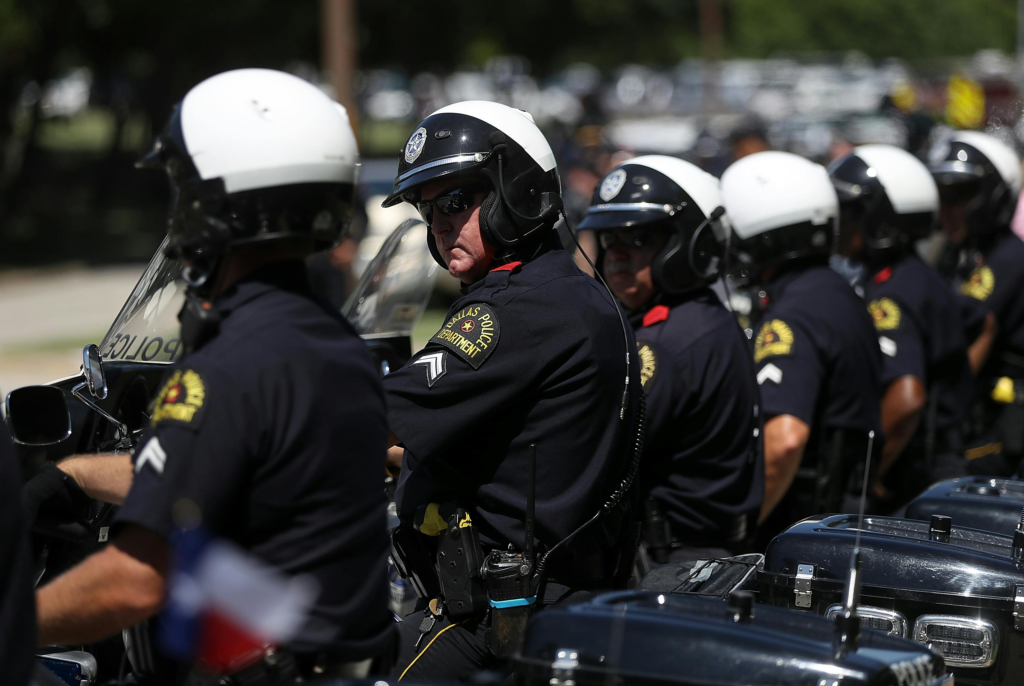
A useful way to understand the system is:
LOCAL LEVEL
Police Departments
Sheriff’s Offices
Constables
School & Campus Police
STATE LEVEL
Texas Department of Public Safety
Texas Highway Patrol
Texas Rangers
SPECIALIZED / MULTI-AGENCY
Cybercrime
Narcotics
Human Trafficking
Organized Crime
Forensics
Major Crimes
FEDERAL PARTNERS
FBI
DEA
ATF
Homeland Security
U.S. Marshals
Other federal agencies
The agencies don’t all perform the same job. Their jurisdictions and responsibilities overlap in some situations, but they generally have distinct missions.
1. Local Police Departments
For most Texans living in incorporated cities, the local police department is likely to be the law-enforcement agency they encounter most frequently.
Municipal police departments generally handle crimes and public-safety issues occurring within their city’s jurisdiction. Their responsibilities can include:
- Emergency calls
- Traffic enforcement
- Theft
- Burglary
- Assault
- Robbery
- Domestic-violence calls
- Vehicle theft
- Missing-person investigations
- Crash response
- Community policing
- Criminal investigations
A city’s police department is therefore often the front line of everyday policing. Texas currently has hundreds of municipal law-enforcement agencies, reflecting the state’s unusually decentralized structure.
2. County Sheriff’s Offices
Sheriffs operate at the county level. Texas has 254 counties, and TCOLE’s current agency data includes 254 sheriff’s offices. A sheriff’s office may be particularly important in areas that don’t have their own municipal police department. Sheriff’s offices commonly handle:
- Patrol
- Criminal investigations
- Jail operations
- Court security
- Prisoner transportation
- Warrants
- Rural law enforcement
- Civil-process duties
The exact responsibilities can vary considerably from county to county. In a large metropolitan county, the sheriff’s office may operate a substantial jail and specialized divisions. In a small rural county, the same office may operate with a much smaller staff and a broader range of responsibilities.
Police Department vs. Sheriff’s Office
This is one of the most common sources of confusion.
Police Department: Generally serves a city or municipality.
Sheriff’s Office: Generally serves a county and is headed by an elected sheriff. So someone might live:
Inside city limits → primarily police jurisdiction
while another person living:
Outside incorporated city limits → primarily sheriff’s jurisdiction
There are exceptions and overlapping responsibilities, so jurisdiction can depend on the specific location and incident.
3. Texas Constables
Constables are another distinctive part of Texas law enforcement. Texas has a large constable system, with 671 constable agencies listed in TCOLE’s 2024 agency data. Constables are elected at the precinct level and can perform law-enforcement duties. Their responsibilities can include:
- Serving civil process
- Executing warrants
- Court-related duties
- Traffic enforcement
- Criminal enforcement
- Supporting other law-enforcement agencies
The role varies considerably by county. In some areas, constable offices have significant patrol and investigative responsibilities. In others, their work is more heavily focused on courts and civil process.
4. Texas Department of Public Safety
Now we reach one of the most recognizable state-level agencies: Texas Department of Public Safety — DPS
DPS is not simply “the state police.” It is a large, multi-mission public-safety agency, it’s esponsibilities include law enforcement, driver licensing, crime records, forensic services, intelligence, emergency response and other statewide functions.
DPS was established in 1935, bringing together the Texas Highway Patrol and the Texas Rangers under one department. In 2025, the agency marked its 90th anniversary. Today, DPS describes itself as one of the nation’s comprehensive public-safety agencies.
5. Texas Highway Patrol
The Texas Highway Patrol is the part of DPS most Texans probably recognize immediately. Troopers patrol Texas highways and respond to incidents involving:
- Traffic violations
- Crashes
- Highway safety
- Criminal activity encountered during patrol
- Major roadway incidents
But Highway Patrol isn’t limited to writing speeding tickets. Troopers can become involved in criminal investigations, emergency response and large-scale public-safety operations. Texas is so geographically large that maintaining statewide highway coverage is itself a major law-enforcement challenge.
6. The Texas Rangers
Then there are the legendary Texas Rangers. They have one of the longest histories of any law-enforcement organization in the United States. Their roots go back to 1823, making the Rangers older than the Republic of Texas itself. When DPS was created in 1935, the Rangers became part of the new department.
Today, the Rangers are not simply frontier-style patrolmen. Their work includes specialized investigations such as:
- Major violent crimes
- Homicides
- Public corruption
- Officer-involved incidents
- Organized crime
- Cold cases
- Other complex investigations
Their role is generally more specialized than routine local patrol.
What Makes the Texas Rangers Different?
Think of it this way; A local police officer might respond to a burglary. A detective might investigate it. But when an investigation becomes unusually complex, serious or falls within a specialized state mission, the Rangers may become involved depending on the circumstances and jurisdiction. They’re essentially part of Texas’ specialized investigative capability.
7. Specialized Crime Units
Modern Texas policing extends far beyond patrol cars. Law-enforcement agencies operate specialized units dealing with crimes such as:
Cybercrime: Investigating hacking, digital fraud and electronic evidence.
Human trafficking: Investigating trafficking organizations and protecting victims.
Narcotics: Targeting drug trafficking organizations.
Organized crime: Investigating criminal networks rather than isolated offenders.
Homicide: Conducting complex death investigations.
Financial crime: Following fraud, money laundering and other financial activity.
Forensics: Analyzing physical and digital evidence.
DPS specifically identifies capabilities including intelligence and crime analysis, violent-crime investigations, drug investigations, gang investigations, human-trafficking investigations, cyber investigations, forensic laboratory analysis and cold-case investigations.
8. Texas Law Enforcement and Cybercrime
This deserves special attention because crime has increasingly moved online. Texas DPS operates a Computer Information Technology and Electronic Crime (CITEC) Unit, which specializes in computer and electronic evidence and investigates crimes involving computers and the internet. Modern investigations may involve:
- Smartphones
- Computers
- Cloud accounts
- Social media
- Digital payments
- Cryptocurrency
- Network activity
- Deleted electronic evidence
This means today’s detective may need knowledge that would have been unimaginable to investigators decades ago.
9. School and Campus Police
Texas also has dedicated law enforcement within educational institutions. TCOLE’s agency data lists 361 independent-school-district police agencies and 77 college agencies, along with private-college and other education-related agencies.
These officers can play an important role in:
- School security
- Emergency response
- Threat assessment
- Campus patrol
- Investigations
- Student safety
- Coordination with local police
School police have become increasingly important as Texas communities focus on preventing and responding to threats against educational institutions.
10. How Agencies Work Together
This is arguably the most important part of understanding Texas policing. A major crime doesn’t necessarily belong to only one agency. Imagine a case involving:
A stolen vehicle used in a Robbery connected to Organized crime with suspects operating across Multiple counties. The investigation could involve local police, sheriff’s offices, DPS and potentially federal agencies. Information-sharing becomes essential.
DPS provides authorized agencies access to major criminal-justice information systems, including the Texas Crime Information Center, criminal-history records, Texas Gang Intelligence Index, DNA databases and other systems.
Why Texas Needs So Many Agencies
At first glance, having thousands of law-enforcement agencies may seem inefficient. But Texas’ geography explains much of the structure. The state contains:
- Huge metropolitan areas
- Small rural communities
- Border regions
- Coastal communities
- Major interstate corridors
- Oil and gas regions
- Agricultural areas
- International ports
- Large university populations
The policing needs of downtown Houston aren’t identical to those of a tiny rural county. Local agencies therefore provide local knowledge and local response, while larger agencies can provide specialized capabilities.
The Small-Agency Challenge
Texas has another unusual characteristic:
Many agencies are very small. DPS has noted that a large majority of Texas law-enforcement agencies have relatively small staffing levels, making it difficult for many agencies to maintain specialized capabilities around the clock. That makes cooperation particularly important. A small rural department may not have:
- A cybercrime laboratory
- A homicide unit
- A bomb squad
- A large SWAT team
- A major-crimes analyst
- Extensive forensic resources
Instead, it can rely on larger agencies and state resources when necessary.
Training Texas Police Officers
Law enforcement is not simply about putting someone in a uniform. Texas regulates peace-officer licensing and training through the:
Texas Commission on Law Enforcement — TCOLE
TCOLE establishes licensing standards and oversees training and continuing education for Texas peace officers and other regulated law-enforcement personnel. Its current statistics show more than 83,000 active peace-officer licenses. Training covers areas such as:
- Texas law
- Ethics
- Use of force
- Firearms
- Emergency response
- Communication
- Investigation
- Crisis intervention
- Professional conduct
And training doesn’t stop when an officer graduates from an academy. Continuing education is an ongoing requirement.
Professional Standards and Accreditation

Texas also has organizations focused on improving policing standards. The Texas Police Chiefs Association (TPCA) promotes professional development, training, ethical standards and cooperation among Texas law-enforcement leaders. As of 2026, TPCA reports:
- 231 accredited agencies
- 173 standards
- 66 training classes annually
The accreditation program is intended to encourage agencies to follow recognized professional practices.
What Happens When You Call 911?
The process can look simple from the outside. You call: 911, them the emergency communications determine the nature and location of the incident. The appropriate agency is notified and officers are dispatched. On arrival. the officers assess the situation and evidence may be collected. After which Investigators become involved when necessary. The case may eventually move to prosecutors and the courts. The responding officer is therefore only one part of a much larger criminal-justice system.
Police Are Not the Same as Prosecutors
Another important distinction:
Police investigate crimes, Prosecutors decide whether and how to bring criminal charges.
After an investigation, prosecutors may review the evidence and determine whether charges should be filed. The court system then determines guilt or innocence according to the law. So note that police are not prosecutors and prosecutors are Courts. While they’re connected, they perform different functions.
What Texans Should Know About Police Jurisdiction
If you’re unsure which agency serves your location, don’t assume the nearest police station is automatically responsible. Jurisdiction can depend on:
- City limits
- County boundaries
- State highways
- Special districts
- School property
- Campus boundaries
- The type of incident
This is one reason emergency dispatchers ask for your exact location.
What Should You Do During a Police Emergency?
If you need immediate police assistance: Call 911 when there is an immediate threat or emergency, then give the dispatcher:
- Your exact location
- What happened
- Whether anyone is injured
- Description of the suspect
- Direction of travel
- Vehicle information
- Whether weapons are involved
Try to remain on the line unless the dispatcher tells you otherwise. For non-emergency matters, use your local agency’s non-emergency contact rather than tying up emergency lines.
What About Texas’ Border?
Texas shares a roughly 1,200-mile international border with Mexico, creating another major law-enforcement responsibility for state agencies. Border-related public-safety operations can involve:
- Human smuggling
- Drug trafficking
- Human trafficking
- Vehicle crime
- Organized criminal networks
DPS has specifically identified drug and human-smuggling organizations as major threats requiring coordinated state and local responses. This is another area where local, state and federal cooperation becomes essential.
Texas Police and Natural Disasters
Texas law enforcement also plays a major role when the threat isn’t a criminal. During:
- Hurricanes
- Floods
- Wildfires
- Severe winter weather
- Tornadoes
- Major accidents
Policies and other public-safety agencies can assist with:
- Evacuations
- Road closures
- Search and rescue
- Traffic management
- Security
- Emergency communications
- Disaster response
DPS specifically lists major floods, wildfires and hurricanes among the threats its public-safety mission addresses.
How Modern Texas Policing Is Changing

Texas police departments are becoming increasingly technology-driven. Modern agencies may use:
- Body cameras
- Automated license-plate readers
- Drones
- Data analytics
- AI-assisted tools
- Digital forensics
- Real-time crime centers
- DNA databases
- Mobile digital evidence
This doesn’t eliminate traditional policing. Instead, it gives officers and investigators more information to work with.
The Numbers Behind Texas Law Enforcement
The figures demonstrate why describing Texas law enforcement as simply “the Texas police force” doesn’t accurately represent how the state operates. It is a network.
The Biggest Law-Enforcement Agencies
Texas’ largest metropolitan areas naturally have some of the state’s largest police organizations. These include departments serving communities such as:
- Houston
- San Antonio
- Dallas
- Austin
- Fort Worth
- El Paso
- Arlington
- Corpus Christi
But size isn’t everything. A small rural department may have only a handful of officers while still performing essential public-safety functions for its community. The difference is primarily scale and specialization, not importance.
Why Community Cooperation Matters
Police can’t effectively prevent every crime alone. Residents provide information that technology cannot always produce. A witness may recognize:
- A suspect
- A vehicle
- A suspicious pattern
- A missing person
- A location repeatedly targeted by criminals
Community reporting therefore remains an important part of crime prevention. The relationship works best when residents understand their role as partners in public safety rather than passive observers.
Accountability Matters Too
Effective policing requires public trust. That means law-enforcement agencies must balance Public safety with Individual rights and Accountability. Modern concerns include:
- Use of force
- Surveillance
- Data privacy
- Body-camera policies
- Police misconduct
- Training standards
- Transparency
These aren’t arguments against policing. They’re part of the larger question of how law enforcement can remain effective while maintaining public confidence.
The Future of Texas Law Enforcement
The Texas police officer of the future may still drive a patrol vehicle, respond to calls and speak directly with residents. But behind that officer will increasingly be:
Data analysts
Digital-forensics specialists
Cyber investigators
Drone operators
Real-time intelligence systems
Automated cameras
State databases
Federal partnerships
The profession is becoming more technologically sophisticated without abandoning its most basic responsibility: Protect people, enforce the law and respond when communities need help.
Frequently Asked Questions

1.Is the Texas Department of Public Safety the same as the Texas police?
No. DPS is a statewide public-safety and law-enforcement agency. Texas also has hundreds of municipal police departments, sheriff’s offices, constables and specialized agencies.
2.What is the difference between Texas DPS and local police?
Local police generally serve specific municipalities, while DPS has statewide responsibilities and specialized capabilities, including the Texas Highway Patrol and Texas Rangers.
3.Are Texas sheriffs police officers?
Sheriff’s deputies are law-enforcement officers. A sheriff’s office operates at the county level rather than as a municipal police department.
4.Who investigates major crimes in Texas?
It depends on the case. Local detectives may handle many serious crimes, while specialized cases can involve sheriff’s offices, DPS, Texas Rangers or federal agencies.
5.How many police officers are in Texas?
TCOLE’s current statistics list 83,685 active peace-officer licenses, although license counts are not necessarily identical to the number of individual officers actively working because individuals can hold multiple license types.
6.Does every Texas city have its own police department?
No. Some communities rely on county sheriff’s offices or other arrangements rather than maintaining a traditional municipal police department.
7.Who patrols Texas highways?
The Texas Highway Patrol, part of DPS, has statewide highway-safety and law-enforcement responsibilities.
8.Are Texas Rangers the same as state troopers?
No. Both are part of DPS, but they perform different functions. Highway Patrol troopers focus heavily on highway safety and statewide patrol responsibilities, while Texas Rangers perform specialized investigative work.
Final Words
Texas doesn’t have one police force, It has something much bigger: a statewide law-enforcement network. Local police departments protect cities. Sheriff’s offices serve counties. Constables perform specialized county-level duties. School and campus police protect educational communities. Texas Highway Patrol troopers handle statewide highway responsibilities. Texas Rangers investigate complex and specialized cases. DPS provides statewide capabilities, intelligence, technology and investigative support. And federal agencies become involved when cases cross into federal jurisdiction or require resources beyond the state.
That structure can sometimes look complicated. But it exists for a reason. Texas is simply too large, too diverse and too geographically complex for one agency to handle every public-safety challenge. The strength of the system therefore isn’t just the number of officers.
It’s the ability of thousands of law-enforcement professionals across hundreds of agencies to work together when Texans need them most. And as crime becomes increasingly digital, organized and cross-jurisdictional, that cooperation will probably matter more, not less in the years ahead.