Crime prevention is often discussed as something that happens after a crime occurs, police respond, investigators collect evidence, and courts determine what happens next. But some of the most important prevention efforts happen before a crime is committed.
A suspicious vehicle noticed by a neighbor. A resident who recognizes that an elderly neighbor is being targeted by a scam. A community that notices repeated break-ins and works with local police to improve lighting and security. These seemingly small observations can become part of a much larger safety network. That is the basic idea behind Neighborhood Watch.
But there is an important question behind the concept; Does having neighbors watch out for one another actually reduce crime, or does it simply make people feel safer?
The evidence suggests that Neighborhood Watch can reduce crime, although its effectiveness depends heavily on how the program is organized and what it does beyond simply asking residents to “keep an eye out.” A major systematic review by the Campbell Collaboration examined 19 studies covering 43 evaluations, with a more detailed meta-analysis covering 18 evaluations. It found that Neighborhood Watch was associated with a 16% to 26% relative reduction in crime, although researchers also emphasized limitations in the quality and consistency of the available evidence. That makes Neighborhood Watch worth taking seriously, but not blindly.
What Is Neighborhood Watch?
Neighborhood Watch is a community-based crime-prevention approach in which residents work together to improve awareness, communicate about safety concerns and cooperate with law enforcement.
The basic principle is simple: Residents know their neighborhoods. Police know how to investigate and respond to crime. Neighborhood Watch attempts to connect those two sources of knowledge. A typical program may involve residents:
- Getting to know their neighbors
- Identifying recurring safety problems
- Reporting suspicious activity
- Sharing legitimate safety information
- Improving home and property security
- Organizing community meetings
- Communicating with local law enforcement
- Looking out for vulnerable residents
- Encouraging residents to report crimes rather than ignoring them
It is important to understand that Neighborhood Watch is not a private police force. Members aren’t supposed to chase suspects, conduct investigations, confront suspected criminals or put themselves in dangerous situations. Their role is primarily observation, communication, prevention and reporting.
How Does Neighborhood Watch Actually Work?
The traditional Neighborhood Watch model can be thought of as a chain:
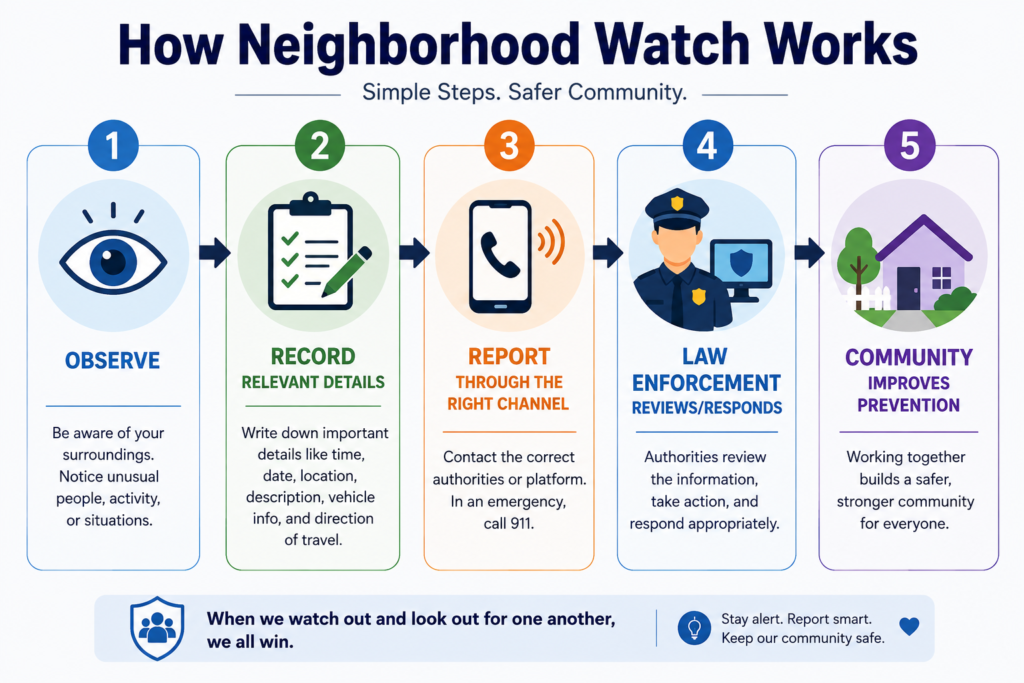
For example, imagine a neighborhood experiencing repeated vehicle break-ins. Residents begin communicating about the incidents and notice that many occur late at night in poorly lit areas. Instead of confronting people they suspect, residents document relevant information and report incidents appropriately.
The neighborhood then works with local authorities and property owners to improve lighting, security cameras and other protective measures. The result isn’t simply “more people watching.”
It is a combination of information + environmental improvements + reporting + law-enforcement cooperation. That distinction is important because research suggests Neighborhood Watch is often most effective when combined with other prevention measures.
The Campbell review identified combinations involving Neighborhood Watch, property marking and home-security surveys, sometimes referred to as the “big three” as common components of evaluated programs.
Does Neighborhood Watch Actually Reduce Crime?
Yes. but the answer needs context.
One of the most frequently cited pieces of research is the systematic review by Trevor Bennett, Katy Holloway and David Farrington. The researchers examined 19 studies covering 43 evaluations and then conducted a meta-analysis of 18 evaluations that contained sufficient information for statistical comparison.
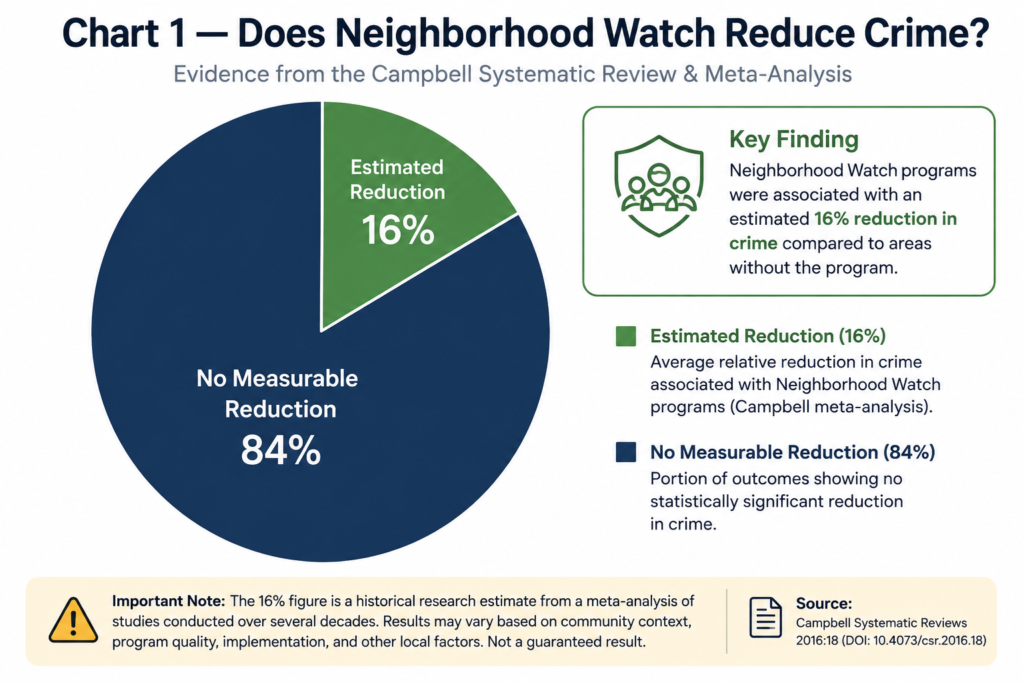
The overall finding was encouraging: Neighborhood Watch was associated with a relative crime reduction of approximately 16% to 26%, depending on the statistical model used.
The U.S. Department of Justice’s National Institute of Justice similarly summarizes the research as showing a positive effect, with the analysis finding approximately a 16% reduction in crime in participating areas compared with comparison areas under the fixed-effects model. But there is an important qualification. The researchers did not conclude that every Neighborhood Watch program will automatically reduce crime by 16–26%.
The studies varied considerably, and the review itself called for more high-quality research. Some programs showed positive effects, others showed uncertain results, and a smaller number showed unfavorable outcomes. So the responsible conclusion is: Neighborhood Watch appears to have a modest but meaningful crime-prevention effect, particularly when it forms part of a broader community-safety strategy.
What the Research Actually Found
Here’s a useful way to understand the evidence:
| Finding | What It Means |
| 19 studies / 43 evaluations | The broader systematic review examined a substantial body of evaluations |
| 18 evaluations | Included in the detailed meta-analysis |
| 15 of 18 | Found a favorable direction of effect in the meta-analysis |
| 16–26% | Approximate relative crime reduction found across statistical models |
| Evidence limitations | Researchers cautioned that more rigorous evaluations were needed |
The original review found that 15 of the 18 evaluations in its meta-analysis showed evidence favoring Neighborhood Watch. That doesn’t mean the other three automatically prove that Neighborhood Watch causes crime to increase. Rather, they demonstrate why crime-prevention programs need to be evaluated carefully rather than assuming the same result everywhere.
Why Could Neighborhood Watch Reduce Crime?
1. More People Notice Suspicious Activity
A criminal may be less likely to operate unnoticed when residents are paying attention to their surroundings. Neighborhood awareness can increase the likelihood that unusual activity is noticed and reported.
2. Better Security
Neighborhood Watch can encourage residents to improve locks, lighting, cameras, alarms and other security measures. This is sometimes referred to as target hardening, making a property more difficult or less attractive to attack.
The National Institute of Justice identifies increased home security and property marking as possible mechanisms through which Neighborhood Watch programs can contribute to crime reduction.
3. Faster Information Sharing
A community that communicates effectively can identify patterns more quickly. For example: Three homes experience package thefts → residents recognize a pattern → property managers and police are informed → security measures are improved. Without communication, each incident may remain isolated.
4. Greater Police Awareness
Residents can provide information that law enforcement may not otherwise receive. But that information needs to be specific and relevant, not based on assumptions about someone’s appearance, race, clothing or social status.
5. Stronger Community Connections
Neighborhood Watch can also improve communication between residents. That matters because a connected community may be better positioned to identify problems, support vulnerable residents and respond collectively to recurring safety concerns.
Neighborhood Watch Isn’t About Watching Everyone
This is one of the most important parts of the entire concept. Suspicious behavior is not the same thing as suspicious-looking people. A person walking through a neighborhood, sitting in a parked car, taking photographs or knocking on doors is not automatically committing a crime. Effective Neighborhood Watch focuses on observable behavior and circumstances, not stereotypes.
For example: Useful observation: “A person is repeatedly trying to open parked vehicles at 2 a.m.” That’s specific and potentially relevant.
Poor assumption:
“That person doesn’t belong in this neighborhood.” That’s subjective and can lead to unnecessary confrontation or inappropriate reporting. The goal is to recognize potentially criminal behavior, not police your neighbors.
Neighborhood Watch vs. Vigilantism
These two concepts should never be confused. Neighborhood Watch members should generally observe, document and report. They should not:
- Chase suspects
- Physically restrain people
- Carry out their own interrogations
- Break into someone’s property
- Threaten suspected criminals
- Follow people around
- Search someone’s belongings
- Attempt to determine guilt themselves
If someone witnesses an immediate threat, the appropriate response is to contact emergency services rather than attempting to personally intervene. The safest Neighborhood Watch member is often the person who gets useful information to the right people without becoming part of the confrontation.
What Should Neighborhood Watch Members Actually Watch For?
The exact situations vary by neighborhood, but residents might pay attention to:
Property Crime
- Repeated vehicle break-ins
- Suspicious activity around parked cars
- Attempts to enter homes or businesses
- Repeated package theft
- Vandalism
- Unusual activity around vacant properties
Fraud & Scams
- Repeated scams targeting elderly residents
- Suspicious door-to-door activity
- Fake contractors operating in the neighborhood
- Fraudulent rental or property advertisements
Community Safety
- Dangerous abandoned properties
- Repeated illegal dumping
- Serious traffic-safety problems
- Recurring disturbances
- Potential hazards affecting residents
The objective isn’t to report every unusual event. It’s to recognize patterns and genuinely concerning behavior.
Neighborhood Watch in Texas
Texas provides an interesting case study because community reporting is explicitly incorporated into the state’s public-safety infrastructure. The Texas Department of Public Safety operates iWatchTexas, a community reporting system that allows Texans to report suspicious activity or behavior that may indicate criminal, terroristic or school-safety threats.
As of 2026, DPS says reports can be submitted through the iWatchTexas mobile app, online or by calling 1-844-643-2251. Reports are reviewed by law-enforcement analysts, and reports are confidential; providing contact information is optional.
DPS specifically encourages residents to report behaviors that may indicate potential threats, including attempts to obtain sensitive security information, suspicious photography of security features and certain threatening statements or activities. Important: iWatchTexas is not an emergency service.
If someone is in immediate danger or a crime is happening right now, residents should use 911 rather than waiting for an iWatchTexas submission to be reviewed. DPS explicitly makes this distinction. This creates a useful framework for Texas Neighborhood Watch groups: Emergency → 911
Suspicious activity requiring review → Appropriate local reporting channel / iWatchTexas
Non-emergency neighborhood issue → Local police or appropriate municipal service
Texas Crime Is Changing, and So Is Community Prevention
Neighborhood Watch shouldn’t operate in isolation from broader crime trends. Texas recorded significant declines in several major crime categories in 2025, according to the latest Texas Department of Public Safety annual report available in 2026.
The statewide violent-crime rate fell 13.19% from 2024 to 2025, while the property-crime rate fell 13.31%. Compared with 2021, the violent-crime rate was down 25.12%, while the property-crime rate was down 18.41%. That doesn’t mean every Texas neighborhood became equally safer. Crime can move differently between cities, counties, neighborhoods and offense categories. It does, however, demonstrate why local communities shouldn’t rely on a single year’s crime numbers.
Neighborhood Watch can complement broader crime-prevention efforts by helping residents understand what is actually happening around them, rather than relying solely on statewide headlines.
How Technology Is Changing Neighborhood Watch in 2026
The traditional image of Neighborhood Watch might involve neighbors standing outside and looking around the block. Modern community safety looks very different. Technology can know how to support neighborhood awareness through:
- Security cameras
- Video doorbells
- Neighborhood communication platforms
- Emergency notification systems
- Digital crime alerts
- Online reporting tools
- License-plate information where legally and appropriately used
- Smartphone-based suspicious-activity reporting
But technology also introduces new responsibilities. Residents should avoid publicly posting sensitive personal information, identifying suspected criminals without evidence, or turning neighborhhood groups into online accusation boards. A security camera can provide useful evidence. A Facebook post declaring someone “a criminal” based on a blurry image can create an entirely different problem.
Can Neighborhood Watch Prevent Burglary?
Potentially, Yes.
Burglary and property crime are particularly relevant to Neighborhood Watch because many prevention strategies involve increasing the perceived risk of detection and reducing opportunities for offenders. That can include:
Better lighting + secure doors + visible cameras + attentive residents + timely reporting
But Neighborhood Watch shouldn’t be presented as a replacement for physical security. A resident should still lock doors and windows, secure vehicles, protect valuables and use appropriate security equipment. Community awareness works best when it adds another layer of protection.
How to Start a Neighborhood Watch in Texas
Starting one doesn’t necessarily require an elaborate organization.
Step 1: Identify the Problem
Before creating a group, determine what you’re actually trying to address. Is it:
- Vehicle theft?
- Burglary?
- Package theft?
- Vandalism?
- Fraud targeting residents?
- General neighborhood communication?
Step 2: Talk to Your Neighbors
Find out whether other residents have noticed the same problems.
Step 3: Contact Local Law Enforcement
Ask about existing community-policing or neighborhood-watch programs in your area.
Step 4: Establish Communication Rules
Decide how residents will communicate and what information should and should not be shared.
Step 5: Establish Reporting Procedures
Make sure residents know: Who do we call? When do we call 911? What should be reported through a non-emergency channel? What information should we record?
Step 6: Improve Physical Security
Consider:
- Lighting
- Locks
- Cameras
- Fencing
- Address visibility
- Package-security measures
- Vehicle-security practices
Step 7: Review the Results
After several months, ask:
- Are reported incidents changing?
- Are residents communicating more effectively?
- Are particular locations repeatedly affected?
- Have security improvements helped?
- Are residents reporting appropriately?
That last step is important. A Neighborhood Watch should be evaluated, not simply assumed to be successful.
Common Mistakes That Can Make Neighborhood Watch Less Effective
❌ Turning the group into a rumor network: Unverified information spreads quickly.
❌ Confronting suspected criminals: This can put residents in unnecessary danger.
❌ Reporting people based on appearance: Focus on behavior, not identity or stereotypes.
❌ Posting accusations online: A photograph isn’t proof of criminal responsibility.
❌ Ignoring property security: Awareness doesn’t replace locks, lighting or other security measures.
❌ Reporting everything: Over-reporting insignificant activity can overwhelm communication channels and reduce attention to genuine threats.
❌ Forgetting vulnerable residents: Older adults, people living alone and residents who may have difficulty accessing safety information can benefit significantly from a connected community.
Does Neighborhood Watch Make People Feel Safer?
This is an interesting distinction. Feeling safer and actually experiencing less crime aren’t necessarily the same thing. A neighborhood can become more connected and residents can become more confident without crime necessarily falling.
Conversely, crime could decline without residents feeling safer if fear remains high because of news coverage or highly visible incidents. That’s why a good Neighborhood Watch program should look at measurable outcomes, such as:
- Reported crime
- Repeat incidents
- Property-security improvements
- Response to recurring problems
- Resident participation
- Communication with law enforcement
Rather than relying exclusively on whether residents say they “feel safer.”
So, Does Neighborhood Watch Actually Work?
The best available systematic evidence suggests yes, but modestly, and not automatically. The Campbell systematic review found that Neighborhood Watch was associated with approximately a 16–26% relative reduction in crime, depending on the analytical model. However, the researchers also noted limitations in the evidence and the need for stronger evaluations.
The lesson isn’t that putting up a Neighborhood Watch sign will suddenly eliminate crime, but rather that organized community participation can be one useful layer of crime prevention. Its greatest value may come when residents, property owners and law enforcement work together rather than operating independently.
Neighborhood Watch Safety Checklist
Before starting or joining a Neighborhood Watch program, residents should be able to answer these questions:
☐ Do we know our immediate neighbors?
☐ Do we know how to contact local law enforcement?
☐ Do we know when to call 911?
☐ Do we have a clear non-emergency reporting process?
☐ Do residents understand what constitutes genuinely suspicious behavior?
☐ Do we avoid confronting suspected offenders?
☐ Are homes, vehicles and shared areas adequately secured?
☐ Do residents know how to report suspicious activity in Texas?
☐ Are we protecting people’s privacy?
☐ Are we measuring whether the program is actually helping?
Frequently Asked Questions
1. Is Neighborhood Watch the same as a private security force?
No. Neighborhood Watch is a community crime-prevention and awareness model. Residents generally observe and report rather than enforce the law themselves.
2. Can Neighborhood Watch members make arrests?
Residents should not treat Neighborhood Watch membership as law-enforcement authority. Confronting or attempting to detain someone can create serious safety and legal risks.
3. Does Neighborhood Watch really reduce crime?
Research suggests it can. A major systematic review found an association with approximately a 16–26% relative reduction in crime, although results vary between programs and the evidence has limitations.
4. What should I do if I see a crime happening right now in Texas?
If there is an immediate threat or emergency, call 911. Texas DPS specifically states that iWatchTexas is not intended for emergencies.
5. What is iWatchTexas?
It is a Texas DPS community reporting system for suspicious activity and behavior that may indicate criminal, terroristic or school-safety threats. Reports can be submitted through the app, online or by phone and are reviewed by law-enforcement analysts.
6. Can Neighborhood Watch eliminate crime?
No. No community program can guarantee that. Neighborhood Watch is best understood as one layer of prevention that can complement physical security, policing, environmental improvements and responsible reporting.
Final Takeaway
Neighborhood Watch isn’t about turning ordinary residents into police officers. It is about creating communities where people know their surroundings, communicate responsibly, recognize genuine warning signs and know when and how to report them.
The research gives the concept some credibility: systematic evidence has found a meaningful association between Neighborhood Watch and lower crime, with one major meta-analysis estimating a relative reduction of roughly 16% to 26%. But the evidence also makes clear that results aren’t guaranteed and that program design matters.
For Texas residents, that community role fits into a broader public-safety system that increasingly relies on both traditional law enforcement and public reporting. Texas DPS’s current iWatchTexas program is one example of how residents can contribute information to authorities without taking enforcement into their own hands.
Ultimately, the strongest Neighborhood Watch isn’t the one with the most people staring out of windows. It’s the one where residents know their neighbors, understand the risks, protect their properties, report responsibly and know when to step back and let trained professionals handle the situation.