Carjacking is different from ordinary vehicle theft, In a typical vehicle theft, the owner may not even be present when the vehicle is taken. A carjacking involves the theft or attempted theft of a motor vehicle through force or the threat of force against the driver or another person present. The FBI treats carjacking as a form of robbery when reporting the offense.
That distinction matters because preventing carjacking isn’t simply about making a vehicle harder to steal. It is about reducing opportunities for a criminal to approach you, forcing you into a vulnerable situation, or taking advantage of predictable moments when you are distracted or stationary.
The good news is that carjacking remains relatively uncommon compared with the enormous number of vehicles on American roads. But when it does happen, the consequences can be serious. The best protection therefore isn’t paranoia. It’s awareness, preparation and knowing what to do before, during and after an attempted carjacking.
What Is Carjacking?
Carjacking is the theft or attempted theft of a motor vehicle by force or threat of force. That makes it different from;
Motor vehicle theft
Someone steals a vehicle without confronting the owner. For example, a person breaks into an unattended car parked outside a home and drives away.
Carjacking
The offender confronts the person using the vehicle. For example, someone threatens a driver while the driver is stopped and demands the vehicle.
Both involve vehicle theft, but the immediate safety risk is very different.
How Common Is Carjacking?
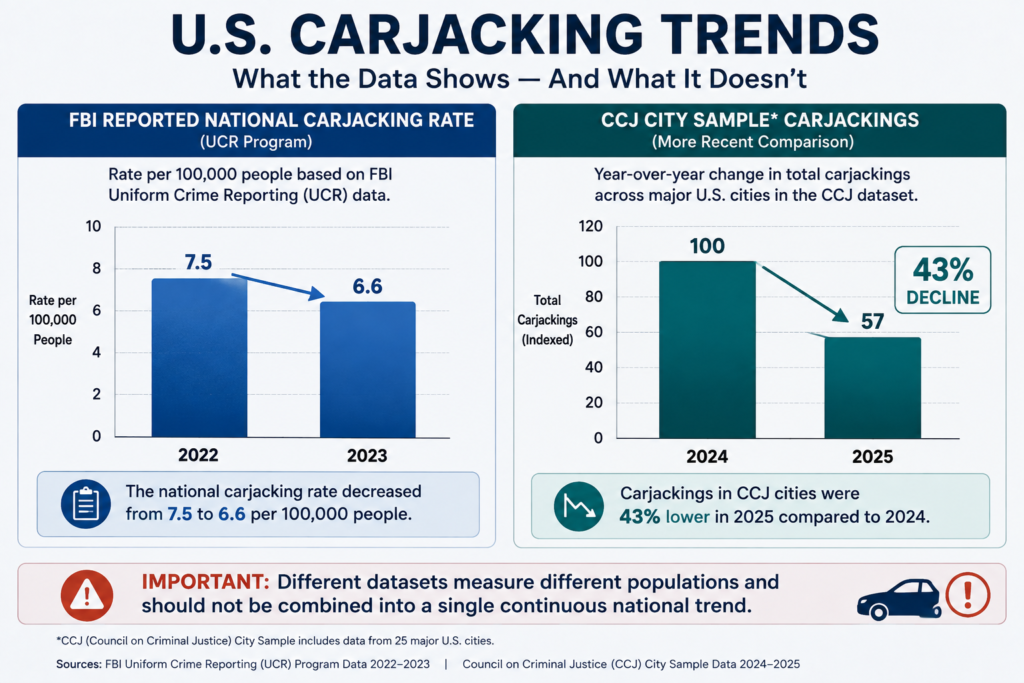
One important point gets lost in sensational coverage; Carjacking is relatively uncommon compared with overall vehicle theft. The FBI’s 2019–2023 analysis found that the national reported carjacking rate increased during much of that period before declining from 7.5 incidents per 100,000 people in 2022 to 6.6 per 100,000 in 2023.
More recent city-level data suggest the decline continued. The Council on Criminal Justice’s year-end 2025 analysis found that among nine large U.S. cities with available carjacking data, the average reported carjacking rate fell 43% from 2024 to 2025. The 2025 rate was approximately 29% below 2019 levels and 61% below the 2023 peak in that sample.
That doesn’t mean carjacking has disappeared. It means the risk should be understood in context rather than through isolated headlines.
Carjacking vs. Vehicle Theft: The Numbers Tell Two Different Stories
This distinction is particularly important when reading crime statistics.
| Crime | What happens? | Typical situation |
| Vehicle theft | Vehicle is stolen | Owner isn’t necessarily present |
| Carjacking | Vehicle is stolen using force or threat | Driver/passenger is confronted |
| Attempted carjacking | Attempt is made but vehicle isn’t successfully taken | Confrontation occurs |
| Robbery | Property is taken through force/threat | Vehicle may or may not be involved |
The FBI reported that the nationwide motor-vehicle-theft rate rose from 199.4 per 100,000 people in 2019 to 283.5 in 2023, although its carjacking rate declined between 2022 and 2023. That demonstrates why vehicle theft statistics shouldn’t automatically be interpreted as carjacking statistics.
Why Do Carjacking Happen?
There isn’t one single motive. A vehicle may be targeted because of:
- Its perceived value
- Its accessibility
- Its location
- The opportunity presented by the driver
- The vehicle itself
- The offender’s desire to use the vehicle for another crime
- Organized theft activity
The circumstances can vary significantly from one incident to another. That means prevention shouldn’t focus exclusively on a particular vehicle make, neighborhood or time of day. Instead, drivers should focus on reducing predictable opportunities.
When Are Drivers Most Vulnerable?
Carjacking can happen in many different settings, but drivers should be particularly conscious of situations where they are:
- Stationary for extended periods
- Distracted by their phone
- Getting in or out of the vehicle
- Sitting in a parked vehicle
- Stopped in isolated areas
- Entering or leaving unfamiliar locations
- Sitting in a driveway or garage
- Waiting in poorly lit areas
- Leaving valuables visible inside the vehicle
The important concept is situational awareness. You don’t need to constantly look over your shoulder. You simply need to remain aware of what’s happening around you.

1. Lock Your Doors While Driving
It sounds obvious, but it is one of the simplest protective measures. Make locking your doors automatic. Many newer vehicles automatically lock once you begin driving, but drivers should still understand their vehicle’s settings rather than assuming. Keeping the doors locked creates another physical barrier between the occupants and someone outside the vehicle.
2. Keep Your Windows Up When Appropriate
Open windows aren’t automatically dangerous. But when you’re stopped in unfamiliar or potentially vulnerable surroundings, keeping windows closed reduces opportunities for someone to reach inside the vehicle. This is especially useful when:
- Sitting at traffic lights
- Stopped in traffic
- Waiting in parking lots
- Entering or leaving unfamiliar areas
3. Don’t Leave Your Car Running Unattended
One of the easiest ways to lose a vehicle is to make it unnecessarily accessible. Avoid leaving the engine running while you:
- Walk into a store
- Collect food
- Open a gate
- Check your mailbox
- Enter your home
- Leave the vehicle unattended
Remote-start systems are different because the vehicle remains secured in many configurations, but drivers should understand exactly how their system works.
4. Be Careful When Approaching Your Vehicle
Your awareness should begin before you get inside the car. When returning to your vehicle:
- Have your keys ready.
- Look around the immediate area.
- Avoid becoming absorbed in your phone.
- Check the back seat if appropriate.
- Enter the vehicle and lock the doors.
This doesn’t mean you should become suspicious of everyone around you. It simply means don’t walk toward your vehicle completely distracted.
5. Look Around Before Pulling Away
Once you’re inside, take a moment to check your surroundings. If someone or something makes you uncomfortable, you don’t necessarily have to drive away immediately. You can remain inside with the doors locked and reassess the situation. If necessary, leave the area.
6. Be Aware at Intersections
Traffic lights create a predictable vulnerability because vehicles are temporarily stationary. That doesn’t mean you should become distracted or paranoid at every intersection. Instead:
- Keep your doors locked.
- Avoid unnecessary phone use.
- Maintain awareness of nearby vehicles and pedestrians.
- Leave enough space to maneuver around the vehicle ahead when traffic conditions allow.
- Pay attention to unusual activity around the vehicle.
The goal is awareness without distraction.
7. Don’t Let Your Phone Distract You
Your phone can make you vulnerable in two ways. First, it reduces your awareness of your surroundings. Second, it can distract you during the exact moment you need to react to something unexpected. If you’re driving; Drive.
If you need to send a message, make a call or use navigation, handle it before moving or use an appropriate hands-free system.
8. Choose Parking Locations Carefully
Where you park matters. When possible, choose locations that are:
- Well lit
- Populated
- Visible from surrounding buildings
- Close to entrances
- Covered by legitimate security cameras
Avoid unnecessarily isolated parking areas, particularly when you expect to return to the vehicle alone at night.
9. Be Careful in Driveways
Many people think of their driveway as one of the safest places they can be. It can still be a vulnerable moment because you’re focused on:
- Opening a garage
- Unlocking a gate
- Checking the mailbox
- Getting out of the vehicle
- Carrying bags inside
If you have a garage, using it can provide another layer of physical security. Before pulling into your driveway, remain aware of your surroundings.
10. Don’t Assume Someone Who Approaches Your Car Needs Help
Someone might genuinely need assistance. But drivers don’t have to open their doors to determine whether that is the case. If someone approaches your vehicle asking for help, you can communicate through a closed or partially opened window and, if necessary, contact emergency services yourself. This is particularly important if the situation feels unusual or threatening.
11. Trust Your Instincts
This doesn’t mean assuming someone is dangerous because of their appearance. It means paying attention when the situation itself doesn’t feel right.
For example, You park somewhere and notice someone lingering unusually close to your vehicle. You don’t have to confront them. You can simply remain inside with the doors locked and leave when it is safe. That’s a much better strategy than trying to determine someone’s intentions personally.
What If Another Vehicle Appears to Be Following You?
Don’t drive home if you genuinely believe someone is following you. Instead, consider driving toward a:
- Police station
- Busy, well-lit commercial area
- Fire station
- Other populated location
If you believe you are in immediate danger, contact 911. The important thing is to avoid leading an unknown person directly to your home.
What If Someone Attempts to Carjack You?
This is probably the most important section in the article. If someone is actively threatening you and demanding your vehicle, the priority is: Protect your life, not your car. A vehicle can be replaced.
A human life cannot. If an offender has a weapon or is threatening violence, don’t escalate the situation simply to protect the vehicle. Depending on the circumstances, compliance may be the safest option. Avoid:
- Sudden movements
- Arguments
- Threatening the offender
- Trying to physically fight over the vehicle
- Chasing the offender afterward
Once you are safely away from the immediate danger, contact law enforcement.
What If Your Child or Passenger Is Inside?
This can make the situation more complicated. If someone attempts to take your vehicle while passengers are inside, prioritize getting everyone to safety.
Do not automatically accelerate, ram another vehicle or attempt a dangerous maneuver unless you have no alternative and immediate danger requires action. If an offender demands the vehicle, focus on creating distance and getting passengers away from the threat when safely possible. After reaching safety, call 911 and provide as much information as you can.
What Information Should You Tell Police?

If you witness or experience a carjacking, useful information may include:
Vehicle information
- Make
- Model
- Color
- License plate
- Distinguishing features
Suspect information
- Number of people involved
- Clothing
- Approximate height/build
- Distinctive features
Direction
- Where the offender went
- Direction the vehicle traveled
Location
- Exact location
- Nearby intersection
- Parking lot/business
- Highway or road
Don’t put yourself in danger trying to collect information. Your safety comes first.
What Should You Do After Your Vehicle Is Taken?
Once you’re safe:
Call 911: Report the carjacking immediately.
Contact your insurer: Notify your insurance company as soon as practical.
Secure financial and digital accounts: If your vehicle contains:
- Identification
- Bank information
- Passwords
- Work documents
- House keys
- Personal information
take steps to secure anything that could expose you to additional theft or fraud.
Consider your home security: If your house keys were inside the stolen vehicle, particularly alongside identification showing your home address, consider changing locks or taking other appropriate security measures.
Carjacking and Technology in 2026
Modern vehicle technology creates both opportunities and challenges. Many newer vehicles include:
- GPS/location services
- Smartphone connectivity
- Remote locking
- Immobilizers
- Vehicle-tracking systems
- Manufacturer-connected services
These can assist with locating or securing a stolen vehicle. But drivers should understand the privacy and security settings associated with connected vehicles. Don’t leave unnecessary personal information accessible through:
- Navigation history
- Garage-door integrations
- Connected apps
- Vehicle profiles
- Digital accounts
If your vehicle is stolen, contact the manufacturer or connected-service provider if applicable and ask about available security or tracking features.
Carjacking Isn’t the Same as Car Theft
This distinction deserves repeating because it can prevent readers from misunderstanding crime statistics.
The FBI’s motor-vehicle–theft data showed that automobiles represented 78.1% of stolen motor vehicles reported in its 2019–2023 analysis, followed by trucks at 12.2%. But those figures describe motor vehicle theft broadly, not the percentage of vehicles taken through carjacking.
Carjacking is specifically about taking or attempting to take a vehicle through force or threat.
Carjacking Trends Are Moving in the Right Direction
Although individual incidents can be frightening, the latest available national and city-level evidence does not support the idea that carjacking is continuously increasing everywhere. The FBI’s 2023 data showed the reported carjacking rate falling from 7.5 to 6.6 per 100,000 people between 2022 and 2023.
The Council on Criminal Justice’s year-end 2025 analysis found an even larger decline among the nine cities in its carjacking dataset: the average rate fell 43% from 2024 to 2025 and was 61% below the 2023 peak. This broader decline is encouraging. But it doesn’t eliminate the need for prevention. A crime becoming less common statistically doesn’t make an individual victim’s experience any less serious.
What About Texas?
Texas doesn’t publish carjacking as a simple standalone statewide category in the same way some local agencies do. That’s important when interpreting Texas crime statistics.
Texas DPS’s NIBRS guidance specifically explains that carjacking is reported as robbery, with the stolen vehicle identified in the property description. That means you shouldn’t simply take a statewide “motor vehicle theft” number and call all of it carjacking.
They’re different offenses. Texas DPS does, however, maintain current crime reporting through its Crime in Texas program, including quarterly reports covering robbery and motor vehicle theft among other index offenses. That distinction is particularly important for anyone comparing Texas with other states or cities.
A Simple Carjacking Prevention Routine
You don’t need to memorize 30 rules. Build these habits:
Before entering your car, LOOK and check your surroundings. Once inside LOCK and secure the doors. While driving FOCUS and Avoid unnecessary distractions. When stopped OBSERVE and Remain aware of your surroundings. When parking CHOOSE and Use visible, well-lit locations whenever practical. If confronted, DE-ESCALATE so as Protect your life before your property. Afterward REPORT and immediately Contact law enforcement as soon as you’re safe.
Carjacking Prevention Checklist
Before driving:
☐ Keys ready before reaching the vehicle
☐ Vehicle surroundings checked
☐ Doors locked
☐ Phone charged
☐ Navigation set before driving
☐ Valuable items stored out of sight
☐ Vehicle maintained
While driving:
☐ Stay aware at intersections
☐ Avoid unnecessary phone use
☐ Keep doors locked
☐ Don’t engage with aggressive drivers
☐ Trust reasonable safety instincts
At night:
☐ Park in visible areas
☐ Avoid unnecessary isolated locations
☐ Have keys ready
☐ Check surroundings
If confronted:
☐ Stay calm
☐ Avoid sudden movements
☐ Don’t escalate
☐ Prioritize personal safety
☐ Call 911 once safely away
Carjacking vs. Other Vehicle Crimes
| Crime | Force or Threat? | Driver Present? | Main Objective |
| Vehicle theft | Usually no | Usually no | Steal vehicle |
| Carjacking | Yes | Usually yes | Take vehicle through force/threat |
| Robbery | Yes | Not necessarily | Take property |
| Burglary | No direct confrontation required | Usually no | Enter property and steal |
| Attempted carjacking | Threat/force attempted | Usually yes | Take vehicle |
Understanding these distinctions makes crime statistics much easier to interpret.
Frequently Asked Questions
Is carjacking common?
Compared with the enormous number of vehicles on U.S. roads, carjacking is relatively uncommon. Recent city-level data also show substantial declines from the 2023 peak.
Is carjacking the same as stealing a car?
No. Carjacking involves taking or attempting to take a vehicle through force or threat, while ordinary vehicle theft does not necessarily involve confronting the owner.
Should I fight someone trying to steal my car?
Generally, don’t prioritize the vehicle over your life. If someone threatens you with violence, avoiding escalation and getting to safety should take priority.
Should I leave my car running while I quickly go inside somewhere?
It’s better not to leave an unattended vehicle running. Doing so can create an unnecessary theft opportunity.
What should I do if I think someone is following me?
Don’t lead them to your home. Drive toward a populated, well-lit location or police/fire station and contact 911 if you believe you’re in immediate danger.
Can technology help recover a stolen vehicle?
Some newer vehicles have connected services, GPS or manufacturer tracking capabilities. If your vehicle is stolen, contact law enforcement and your vehicle manufacturer or connected-service provider where applicable.
Is Texas experiencing a carjacking epidemic?
The available evidence does not support describing carjacking as continuously increasing statewide. Nationally and in the cities tracked by the Council on Criminal Justice, reported carjacking rates declined substantially through 2025. Texas also requires careful interpretation because carjacking is reported under robbery in NIBRS rather than as a separate statewide index-crime category.
Final Takeaway
Preventing carjacking isn’t about living in fear every time you get behind the wheel. It’s about eliminating unnecessary opportunities. Lock your doors. Stay aware. Avoid distractions. Choose safer parking locations. Don’t unnecessarily engage with strangers or aggressive drivers. And if someone actually threatens you for your vehicle, remember that the vehicle is replaceable, you aren’t.
The broader numbers are encouraging: reported carjacking rates have fallen substantially from their recent peak in the U.S., including a 43% decline in the 2025 city-level sample tracked by the Council on Criminal Justice. But good safety habits remain worthwhile regardless of whether crime is rising or falling. The goal isn’t to predict exactly when a crime might happen. It’s to make yourself a harder target, recognize danger earlier and know what to do if prevention fails.