
When people hear the word “crime,” they often think of dramatic incidents shown on television, armed robberies, assaults, or violent attacks. However, not all crimes involve physical harm. In fact, many of the most commonly reported crimes in Texas and across the United States involve stolen property, damaged belongings, or financial losses rather than violence.
Understanding the difference between violent crime and property crime is important for anyone trying to make sense of crime statistics, local news reports, or public safety discussions. These two categories are used by law enforcement agencies, researchers, and policymakers to measure crime trends and identify safety concerns within communities.
While both types of crime can have serious consequences for victims, they differ significantly in how they occur, the risks they pose, and the impact they have on individuals and neighborhoods.
In this guide, we’ll break down the key differences between violent crime and property crime, examine common examples of each, explore how they affect communities, and explain why understanding these categories matters.
Understanding Crime Categories
Law enforcement agencies typically classify criminal offenses into broader categories to make reporting and analysis easier. Two of the most widely used categories are:
- Violent Crime
- Property Crime
These classifications help authorities track trends, allocate resources, and develop crime prevention strategies. Although some crimes may involve elements of both, most offenses primarily fall into one category.
What Is Violent Crime?
Violent crime refers to offenses in which force, threats, or physical harm are directed toward another person. The defining characteristic of violent crime is that it involves actual violence or the threat of violence against a victim.
Common Examples of Violent Crime
- Murder and homicide
- Aggravated assault
- Robbery
- Sexual assault
- Kidnapping
- Domestic violence involving physical harm
In these cases, the primary target is a person rather than property. For example, if someone uses a weapon to threaten a victim and steals their wallet, the offense is generally classified as robbery, which is considered a violent crime because force or intimidation was used.
What Is Property Crime?
Property crime involves the theft, destruction, or unlawful use of someone else’s property without necessarily using force against a person. The primary goal is usually financial gain or property damage.
Common Examples of Property Crime
- Burglary
- Motor vehicle theft
- Shoplifting
- Vandalism
- Arson
- Theft of personal property
Unlike violent crimes, property crimes generally do not involve direct physical attacks on victims. For example, if a burglar breaks into an empty home and steals electronics while nobody is present, the offense would typically be classified as a property crime.
The Key Difference
The simplest way to understand the distinction is this:
Violent crimes target people.
Property crimes target belongings or assets.
A criminal who assaults a victim commits a violent crime.
A criminal who steals a parked vehicle commits a property crime.
However, some situations can become more complex. For example, if a thief uses force to take a vehicle directly from a driver, the incident may be classified as a violent offense because violence or threats were involved.
Side-by-Side Comparison
| Violent Crime | Property Crime |
| Targets people | Targets property |
| Involves force or threats | Usually does not involve direct violence |
| Higher risk of physical injury | Lower risk of physical injury |
| Often causes physical and emotional trauma | Often causes financial loss |
| Includes robbery, assault, homicide | Includes burglary, theft, vandalism |
Most Common Violent Crimes

When people think of violent crime, homicide is often the first offense that comes to mind. While murder cases typically receive significant media coverage, they account for a relatively small percentage of overall violent crime incidents. In reality, law enforcement agencies respond to a much wider range of offenses that involve force, threats, or physical harm against another person.
Understanding the most common forms of violent crime can provide a clearer picture of the challenges facing communities and why these offenses are treated so seriously under the law.
Aggravated Assault
Aggravated assault is one of the most frequently reported violent crimes. It involves an attack that causes serious bodily injury or includes the use of a weapon, such as a firearm, knife, or other dangerous object. Unlike simple assault, aggravated assault presents a greater risk of severe harm and often carries more serious legal consequences.
Examples may include a physical attack resulting in significant injuries or threatening someone with a weapon during a confrontation.
Robbery
Robbery occurs when property is taken directly from a person through force, intimidation, or threats. This is what separates robbery from theft or burglary, which are generally classified as property crimes.
For example, stealing a wallet from an unattended table would typically be considered theft. However, threatening someone and demanding their wallet is robbery because violence or the threat of violence is involved. The victim’s personal safety is directly at risk, making robbery a violent offense.
Sexual Assault
Sexual assault is a serious violent crime involving non-consensual sexual contact or activity. These offenses can have profound physical, emotional, and psychological effects on victims that often last long after the incident itself.
Because of the sensitive nature of these crimes, many cases go unreported, meaning official statistics may not fully reflect their true prevalence. Law enforcement agencies and victim support organizations continue to encourage reporting and provide resources for survivors seeking assistance.
Domestic Violence
Domestic violence involves abusive behavior between family members, spouses, former partners, or individuals in intimate relationships. While many people associate domestic violence solely with physical assault, it can also include threats, intimidation, stalking, and other forms of coercive behavior.
Domestic violence is a significant public safety concern because it often occurs behind closed doors and may continue over extended periods. Communities, law enforcement agencies, and support organizations work together to provide protection, intervention, and resources for those affected.
Together, these offenses make up a substantial portion of violent crime reports each year. Although their circumstances differ, they all share a common characteristic: they involve harm, attempted harm, or the threat of harm directed at another person, which is what distinguishes violent crime from property-related offenses.
Most Common Property Crimes

While violent crimes often receive the most public attention, property crimes occur far more frequently in many communities and account for a significant portion of reported criminal activity each year. These offenses generally involve the theft, destruction, or unlawful use of someone else’s property without direct physical harm to the victim.
Although property crimes may not involve violence, their impact can still be substantial. Victims often face financial losses, property damage, insurance claims, lost productivity, and the stress of recovering stolen or damaged belongings. Understanding the most common types of property crime can help individuals recognize risks and take proactive steps to protect themselves.
Burglary
Burglary occurs when someone unlawfully enters a building, home, business, or other structure with the intent to commit a crime inside. Contrary to popular belief, burglary does not always involve theft. A person may commit burglary if they enter a property intending to steal, vandalize, or engage in another criminal act.
Residential burglaries are among the most common forms of property crime and often occur when homes appear unoccupied. Unlocked doors, open windows, poor lighting, and visible valuables can all increase the risk of becoming a target.
Motor Vehicle Theft
Motor vehicle theft involves the unlawful taking of a car, truck, motorcycle, SUV, or other motorized vehicle. In recent years, vehicle theft methods have evolved beyond traditional hot-wiring techniques, with criminals increasingly targeting keyless entry systems, unattended vehicles, and stolen key fobs.
Beyond the loss of the vehicle itself, victims may face transportation challenges, insurance costs, and the inconvenience of replacing important items that were inside the vehicle at the time of the theft.
Larceny-Theft
Larceny-theft is one of the most commonly reported property crimes. It involves taking someone else’s property without permission and without the use of force or threats.
Examples include:
- Shoplifting from retail stores
- Stealing bicycles
- Taking unattended packages
- Pickpocketing
- Theft of personal belongings from public places
Because no direct confrontation is required, larceny-theft often occurs quickly and opportunistically, making awareness and prevention especially important.
Vandalism
Vandalism involves intentionally damaging, destroying, or defacing property belonging to another person or organization. While some incidents may appear minor, the financial cost of repairs can be significant for homeowners, businesses, and local governments. Common examples include:
- Graffiti
- Broken windows
- Property defacement
- Damage to vehicles
- Destruction of public infrastructure
In addition to repair expenses, repeated acts of vandalism can affect community appearance, reduce perceptions of safety, and negatively impact local businesses.
Together, these offenses represent some of the most frequently reported property crimes across the country. While they may not involve direct violence against victims, their financial and emotional consequences can still be considerable. Understanding how these crimes occur is an important first step toward reducing risk and protecting both personal and community assets.
Which Type of Crime Is More Common?
In most areas, property crimes occur more frequently than violent crimes. This is largely because:
- Property crimes often require less confrontation.
- Financial motives drive many offenses.
- Opportunities for theft are more common.
The following chart illustrates a typical distribution of reported crime categories.
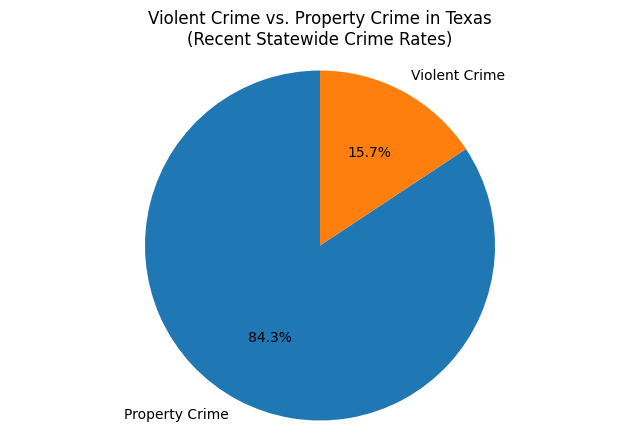
A chart showing the percentage ratio of violent crimes to Property crimes in Texas as of 2026.
Property crimes typically account for a larger share of reported incidents than violent crimes.
Why This Difference Matters
Understanding these categories helps people better interpret crime statistics. For example: A city may report a decrease in violent crime but an increase in vehicle thefts.
Without understanding the distinction, residents may mistakenly assume overall crime is rising or falling across all categories. Crime classifications also influence:
- Law enforcement priorities
- Public safety programs
- Insurance costs
- Community prevention efforts
- Government funding decisions
How Violent Crime Impacts Communities
Violent crime often has effects that extend beyond the immediate victim. Communities experiencing high levels of violent crime may see:
- Increased fear among residents
- Reduced outdoor activity
- Mental health impacts
- Lower perceptions of safety
- Strain on emergency services
Because physical harm is involved, violent crimes often receive significant public attention.
How Property Crime Impacts Communities
Property crime may not always result in physical injuries, but its effects can still be substantial. Victims often experience:
- Financial losses
- Insurance claims
- Property damage
- Lost productivity
- Emotional stress
Repeated property crime can also affect neighborhood confidence and local business activity.
Crime Prevention Strategies Differ
Because violent and property crimes have different causes, prevention strategies often differ as well.
Preventing Violent Crime
- Community policing
- Violence intervention programs
- Youth engagement initiatives
- Domestic violence support services
- Neighborhood partnerships
Preventing Property Crime
- Home security systems
- Vehicle anti-theft measures
- Surveillance cameras
- Improved lighting
- Secure locks and access controls
Understanding the type of crime helps individuals choose appropriate safety measures.
Common Misconceptions

1: All Theft Is Violent Crime
False. Most thefts are classified as property crimes unless force or threats are used.
2: Property Crime Isn’t Serious
False.Property crimes can cause significant financial and emotional harm.
3: Violent Crime Is Always Random
False.Many violent crimes involve individuals who know one another, particularly in domestic violence situations.
Final Words
Violent crime and property crime are often discussed together, but they represent two very different categories of criminal activity. While violent crimes involve force, threats, or physical harm directed at people, property crimes primarily target belongings, assets, and property. Understanding this distinction makes it easier to interpret crime statistics, follow public safety discussions, and better understand the risks facing a community.
Although property crimes tend to occur more frequently, both types of crime can have lasting consequences for victims and neighborhoods. Financial losses, emotional trauma, physical injuries, and reduced feelings of safety can all impact quality of life in meaningful ways.
Ultimately, understanding how crimes are classified isn’t just useful for law enforcement or researchers, it’s valuable for anyone who wants to stay informed about crime trends and make smarter decisions about personal safety. The better informed you are, the better equipped you’ll be to understand the challenges facing your community and the steps that can help reduce risk.